
What the outlet is doing when it trips
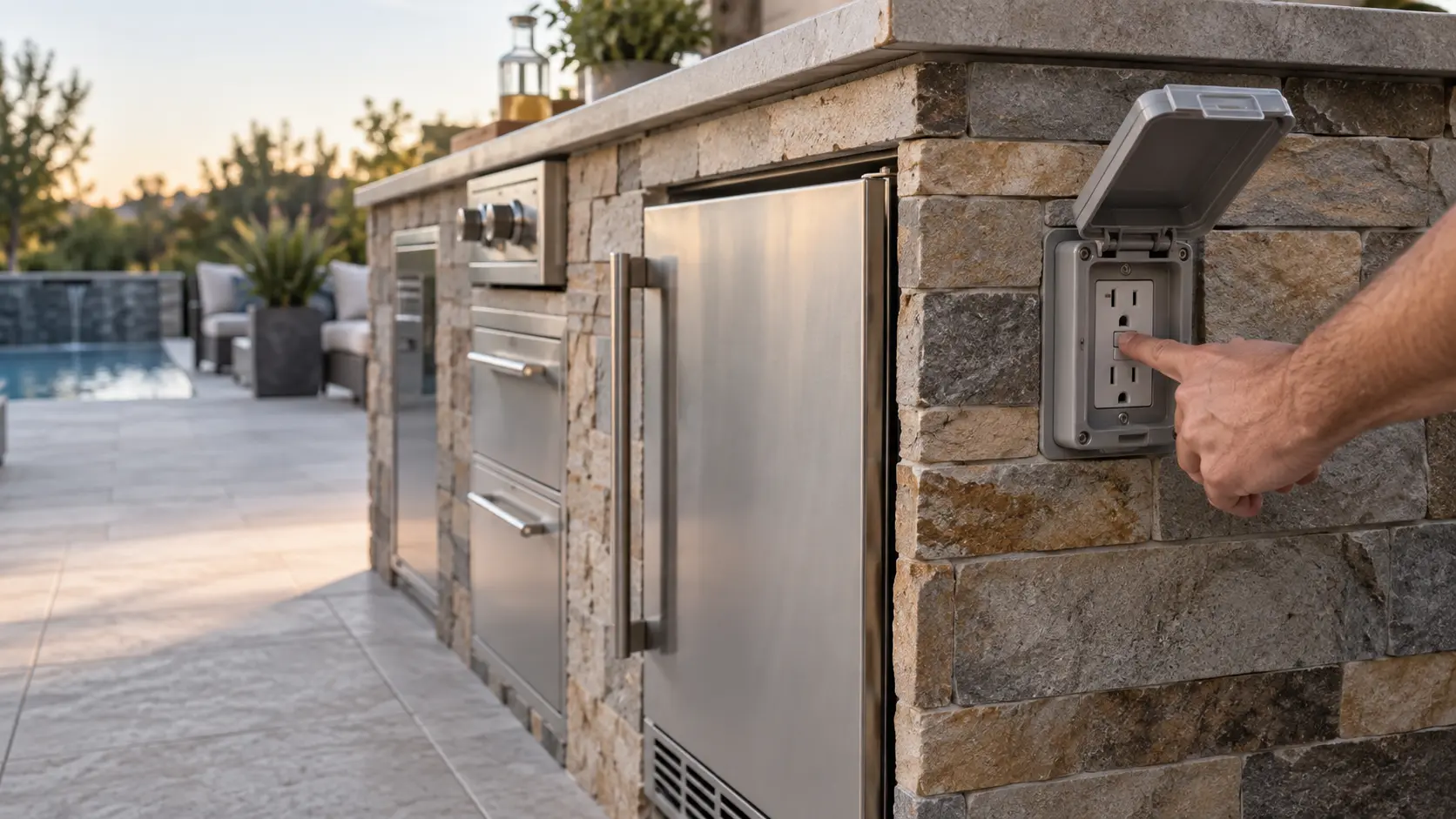
Inside the outlet, a sensor weighs the current leaving on the hot side against the current returning on the neutral. By the CPSC's account, an imbalance of just 0.006 amperes is enough for the device to shut off, in less time than a blink and before a heart rhythm is touched. Whatever current is unaccounted for has found another path home: rainwater, cracked insulation, or someone's hand.
On an island, one protected receptacle often covers every outlet after it on the same line, which the CPSC describes as protection further downstream. That is why the cooler can go dark because of a splash at an outlet on the far side of the counter, and why the first job is finding which device actually tripped.
A trip is not the same as an overload
A standard breaker opens when a circuit draws too much current in total. A GFCI opens when a small amount of current leaks away, even on a lightly loaded circuit. Plugging in fewer things rarely cures a GFCI trip; finding the leak does.
Source: CPSC — GFCIs fact sheet (Pub. 099) — Trips on a 0.006-ampere difference faster than a blink, before it affects the heartbeat; protects outlets further downstream; required for outdoor receptacles since 1973; test monthly and after a power failure; blackouts can damage it; a GFCI that fails the test needs an electrician
Trips that follow rain, sprinklers or a hose-down
The most common pattern on a patio is a trip overnight during a storm, or an hour after the sprinklers ran. Blaze's manual for its outdoor cooling unit says to unplug it before any water goes on it and suggests a waterproof covering where rain is frequent. On an island, water tends to arrive by a handful of routes.
Do not reset into wet conditions. Open the island's breaker while standing somewhere dry, give the island time to dry out, a full sunny day if the cavity got wet, and only then reset. If it holds once dry and trips again with the next rain, the path the water takes is the thing to fix.
- Through a flat outlet cover that can only close when nothing is plugged in.
- Along a cord and into the plug, when the cord droops below the outlet.
- Into the island cavity, where a cord or a connection lies on a base that floods.
- From a sprinkler head or a pool splash aimed at the island face.
- Through a cracked cover or a gasket that has hardened in the sun.
The in-use cover
An outlet with a cord plugged into it all year needs a deep, hinged cover that closes over the plug, often called a bubble cover. A flat cover propped open by the cord lets rain straight in. Look for cracked covers, missing gaskets and sprinkler heads aimed at the island face.
Source: Blaze — Outdoor refrigerator user manual (BLZ-SSRF-50DH) — No water on the unit without unplugging; waterproof covering in rain; dedicated outlet, no extension cord or adapter; electrician-installed GFCI, shock risk without one

Trips when one appliance switches on
A trip that lines up with a sound, the cooler's compressor starting, the outdoor ice maker beginning a harvest, the warming drawer's element coming on, points at that appliance. Moisture in a compressor terminal box, a heater element whose sheath has cracked, or a chewed cord inside the cabinet can all leak just enough current to trip the device without blowing a breaker.
The way to narrow it down is to remove appliances from the circuit one at a time, using only plugs you can reach at the outlet itself while standing on dry ground. Anything that is hard-wired, or whose plug sits inside the island behind a panel, stays connected and goes on the list for the visit.
- Unplug every reachable appliance on the protected circuit and reset once.
- Plug them back one at a time, waiting through a full cycle for each.
- Note which one trips the outlet and at what moment: start-up, running or shutting off.
- Leave that appliance unplugged, and the others running, until the visit.
No extension cords as a workaround
Running the cooler from a cord to an unprotected outlet in the garage trades a nuisance for a shock hazard. Blaze asks for a dedicated outlet, no extension cord or multi-outlet adapter, and a GFCI installed by an electrician, warning that without one electrical shock could result.
Trips with nothing running, or a reset that will not hold
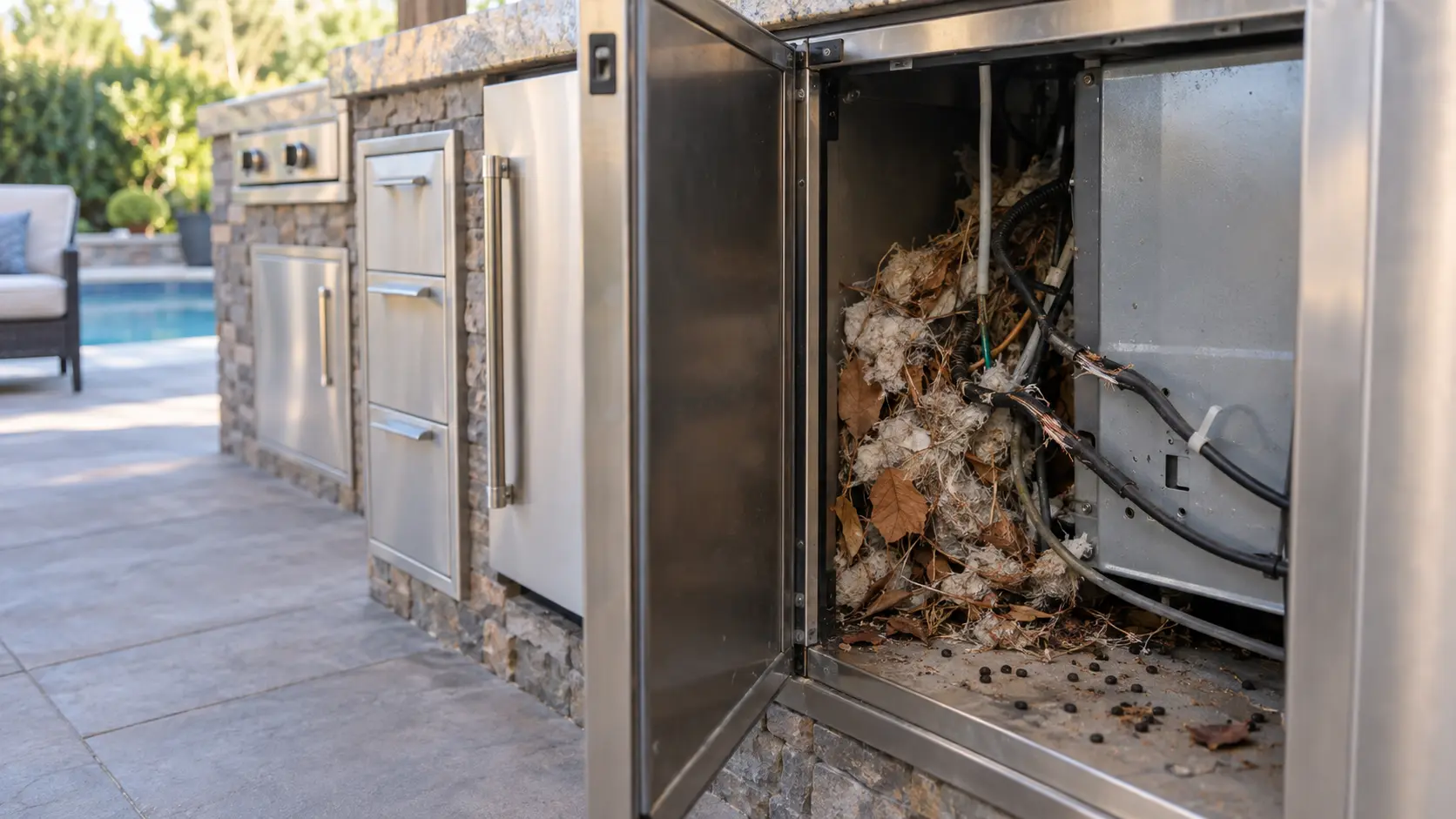
When the outlet trips with every appliance unplugged, or will not reset at all, the leak is in the wiring or the device. Rodents nesting in an island chew insulation, water collects in a junction box inside the base, and a cable pinched during construction can wear through years later. None of it is visible without opening panels, and none of it is an owner's job.
The device itself can also be the problem. Outlets wear out too. According to the CPSC, a blackout or a surge can leave one unable to protect, and a device whose test button no longer kills the power is either failing or wired wrong, which is a job for an electrician.
Signs rodents have been in the island
Droppings in the cabinets, shredded insulation or nesting material behind an access door, and gnawed foam around pipe openings are the usual clues. Close the door, leave the circuit off, and mention it when booking, because chewed wires need finding and replacing along their whole run.
Source: CPSC — GFCIs fact sheet (Pub. 099) — Trips on a 0.006-ampere difference faster than a blink, before it affects the heartbeat; protects outlets further downstream; required for outdoor receptacles since 1973; test monthly and after a power failure; blackouts can damage it; a GFCI that fails the test needs an electrician
Why the fix is never a plain outlet
It is tempting, after the fourth trip of a summer, to ask whether the protected outlet could simply be swapped for an ordinary one. It cannot. The protection exists because an outdoor kitchen puts people with wet hands, metal counters and pool water within reach of live appliances, and the CPSC records that the electrical code has required it outdoors since 1973. A device that trips is telling you something real; the job is to find what.
Source: CPSC — GFCIs fact sheet (Pub. 099) — Trips on a 0.006-ampere difference faster than a blink, before it affects the heartbeat; protects outlets further downstream; required for outdoor receptacles since 1973; test monthly and after a power failure; blackouts can damage it; a GFCI that fails the test needs an electrician