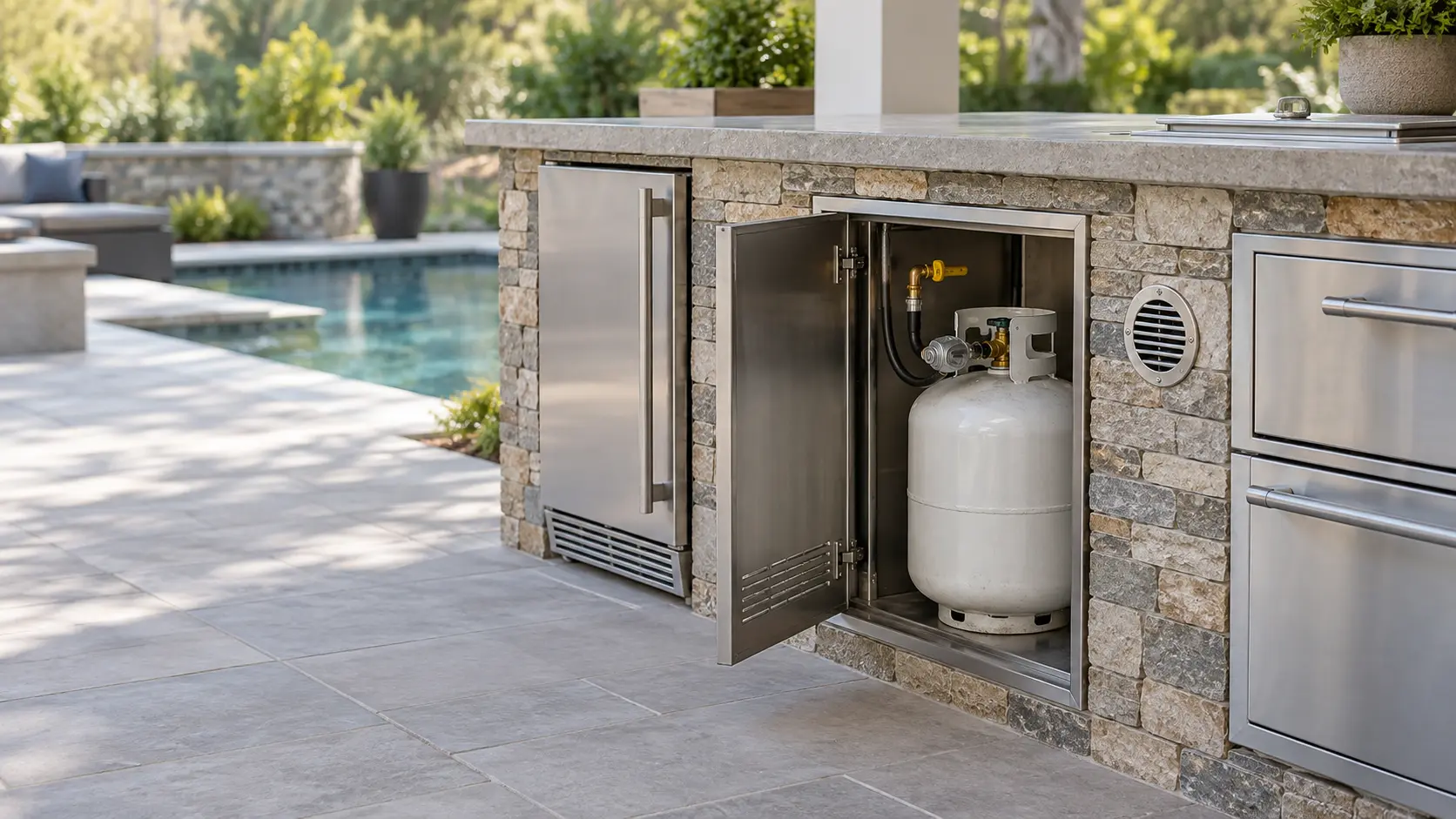
The first minute after you notice gas at the island
Propane and natural gas both carry an added odorant, the sulfur smell people describe as rotten eggs, precisely so that a leak announces itself. For a gas smell at an outdoor kitchen, the makers of outdoor gas appliances print the same short list at the front of their manuals: shut off the gas at its source, put out any open flame, and if the odor continues, keep away from the appliance and call your gas supplier or the fire department.
NFPA's guidance on fuel gas leaks adds the part the patio makes easy to forget. If you are outside and smell gas, leave the area; put out smoking materials and flames; do not operate lights, appliances or phones near the leak, because a spark from any of them can ignite the gas. That includes the island's own lighting, the outlet the ice maker plugs into and the igniter button on the side burner.
- Turn every burner knob on the island to off: side burner, power burner and the cooking head at the far end.
- Close the gas: the valve on top of the propane tank, or the island's shutoff for natural gas, if you can reach it without putting your face into the cabinet.
- Put out candles, torches, cigarettes and the fire pit, and keep anyone from lighting one.
- Leave switches, plugs, the island lights and the igniter alone.
- Move everyone, children and pets included, well away from the island and the patio.
- If the smell stays, call 911 or the gas supplier from a phone away from the area.
Where the island's gas shutoff usually sits
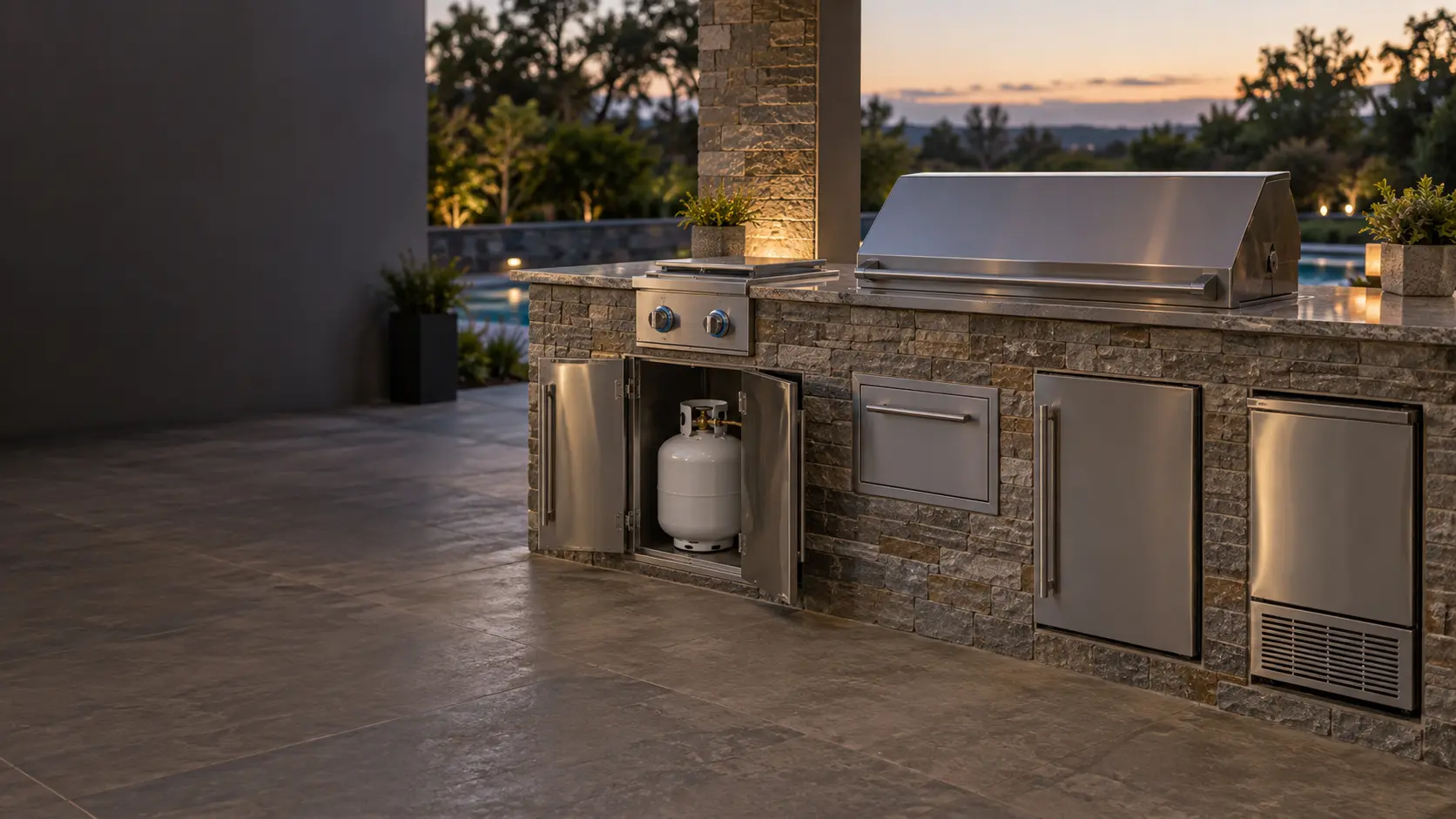
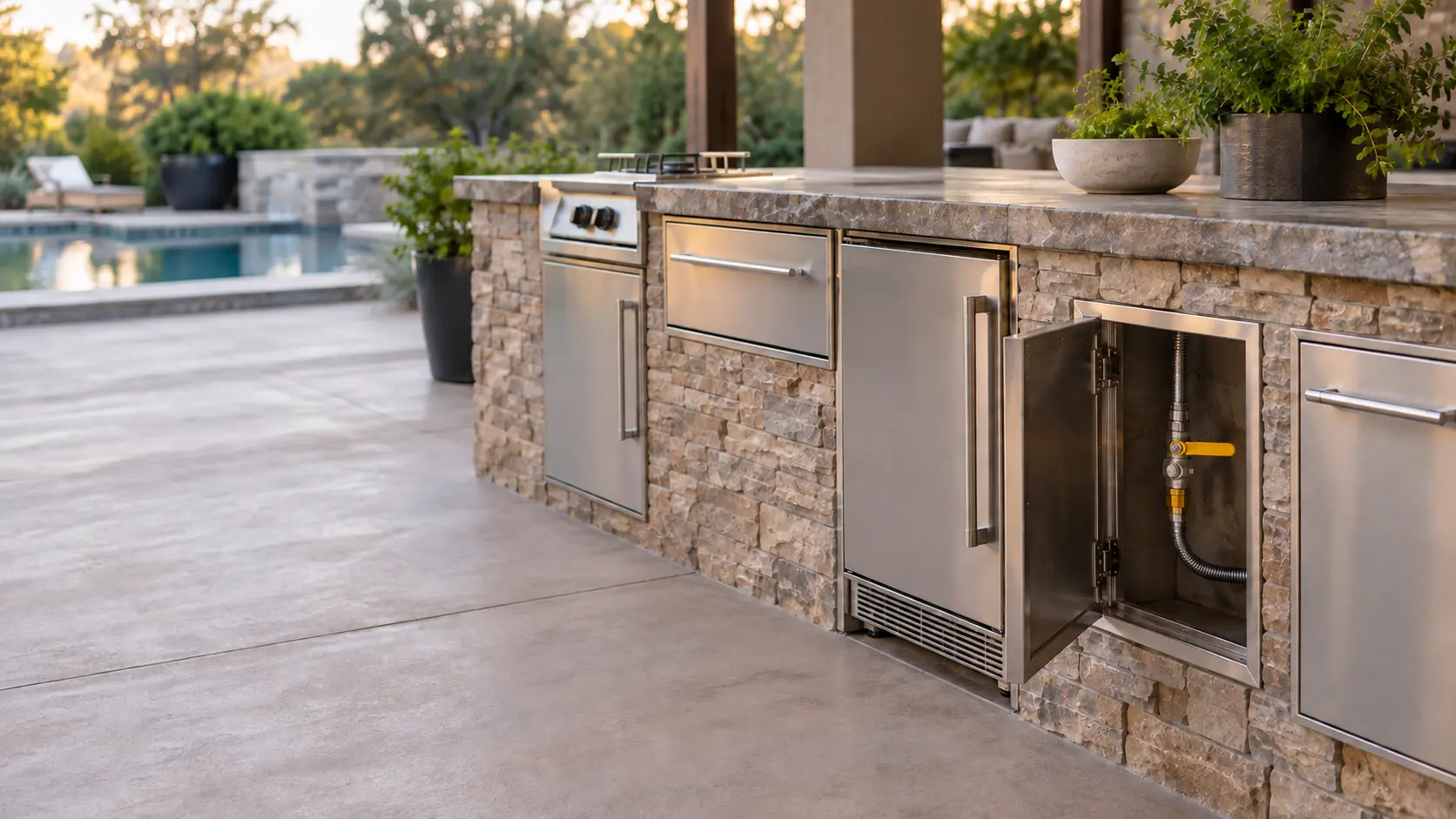
On a propane island the valve is the handwheel on top of the tank, in an open-front compartment or a pull-out tank drawer; turning it clockwise closes it. On a natural gas island the installer puts a manual shutoff where the supply line meets the appliance, behind a small access door, and Blaze requires that valve to stay reachable after installation. Lynx asks the installer to show the owner where it is, which is worth asking for on day one rather than on the evening you need it.
If the cabinet door is the place the smell is strongest, do not open it and reach in. Step away instead and let the supplier or the fire department close the gas upstream.
Source: NFPA — Staying Safer from Natural Gas and Propane Leaks and Explosions (2025) — Fuel gases carry mercaptan so a leak can be smelled; outside and smelling gas, leave the area; no flames, lights, appliances or phones; call 911 or the gas provider from away; do not return until cleared; the provider checks the system before appliances are used; Blaze — Professional Series Use and Care Guide (BLZ-PRO) — If you smell gas, shut off the gas at its source, extinguish flames, keep away and call the gas supplier or fire department; an accessible shutoff valve at the gas connection; propane settles low and natural gas rises in the island cavity; finding and fixing a gas leak is not a do-it-yourself job; Lynx — Side Burner Accessory Care, Use and Installation Manual — Shut off the gas and keep everyone away if odor continues; the installer shows the owner the shutoff; knob off after 4 seconds without ignition and wait 5 minutes; leak checks with soap and water only, never a flame; no damaged cylinders or spare cylinders in the cabinet
Who to call, and from how far away
The call goes to the people who own the gas: the propane company that fills or swaps the tank, or the gas utility for a natural gas line, and 911 if the smell is strong, keeps growing or anyone feels unwell. NFPA's instruction is to find a phone away from the area, report every suspected leak, and not return until the supplier or emergency responders say it is safe.
A repair service is not the first call for an active smell. We come after the gas has been made safe, to find out which fitting, hose, regulator or valve let go, and to replace it.
Why propane and natural gas leak differently in an island
Blaze's installation manual spells out the difference that matters inside a closed cabinet. Propane is heavier than air and settles to the lowest level of the island, so a leak pools along the floor of the bay; natural gas is lighter than air and collects in the highest part of the cavity, under the countertop. Either way, a cabinet without vents can hold gas long after the patio air around it smells clean.
A brief whiff after a failed light is not the same thing
Some gas escapes every time a burner is turned on and does not catch. Lynx says to turn the knob off if the burner has not lit within 4 seconds and wait 5 minutes before trying again; CPSC's gas grill fact sheet says to turn off the gas at the tank if the flame goes out, open the lid and wait 5 to 10 minutes before relighting. A smell that fades in those minutes is that gas clearing. A smell that stays with every knob off is a leak.
Source: NFPA — Staying Safer from Natural Gas and Propane Leaks and Explosions (2025) — Fuel gases carry mercaptan so a leak can be smelled; outside and smelling gas, leave the area; no flames, lights, appliances or phones; call 911 or the gas provider from away; do not return until cleared; the provider checks the system before appliances are used

What the makers let an owner check, and where that stops
The only leak check the makers describe for owners is a soap solution, never a flame. CPSC suggests one part water to one part liquid detergent brushed on the connection points of a propane cylinder with the valve open; NFPA describes spraying or brushing soapy water along the hose, regulator and burner connections, and turning the cylinder off at once if bubbles grow. Lynx asks for that check whenever a tank is reconnected and says never to look for a leak with an open flame.
That check belongs to a routine day with no smell in the air, at a portable cylinder you just connected. It is not a response to a strong odor, and it never extends to the hard piping inside the island. Blaze is blunt about the rest: finding and fixing a gas leak is not a do-it-yourself job, and only a professional should do it.
What stays closed until a technician arrives
- Gas fittings, unions and flare nuts inside the island stay as they are; nobody loosens or tightens them to see if the smell changes.
- Burner valves, the manifold and the regulator stay in place.
- The access panels over the island wiring stay shut.
- The tank valve stays closed once bubbles have shown at a cylinder connection.
- No match, lighter or torch goes near a joint to find the leak.
The hose and the cylinder are the usual suspects
CPSC asks owners to look over gas hoses for cracks, brittleness and holes, to keep them away from hot surfaces and from anywhere grease drips, and never to store a spare propane container under or near the appliance. Lynx adds that a dented, rusty or damaged cylinder should not be used and that spares do not belong in the cabinet. A look, without tools, is fine; a damaged hose is replaced by the part the maker specifies.
Source: Blaze — Professional Series Use and Care Guide (BLZ-PRO) — If you smell gas, shut off the gas at its source, extinguish flames, keep away and call the gas supplier or fire department; an accessible shutoff valve at the gas connection; propane settles low and natural gas rises in the island cavity; finding and fixing a gas leak is not a do-it-yourself job; Lynx — Side Burner Accessory Care, Use and Installation Manual — Shut off the gas and keep everyone away if odor continues; the installer shows the owner the shutoff; knob off after 4 seconds without ignition and wait 5 minutes; leak checks with soap and water only, never a flame; no damaged cylinders or spare cylinders in the cabinet; CPSC — Safety Checks for the Grill (fact sheet, Publication 467) — Soap solution of one part water and one part detergent at the connections; if the flame goes out, turn off the tank and wait 5 to 10 minutes; inspect hoses; never store a spare container under or near the appliance; NFPA — Grilling safety — Brush or spray soapy solution on the hose, regulator and burner connections with the cylinder on; if bubbles form, turn the cylinder off immediately
Before anything on the island is lit again
NFPA's guidance ends with the step people skip: follow the gas supplier's directions before using any gas appliance, because the supplier needs to check the whole system for leaks. Leave the tank valve closed and the knobs off until that check is done, and tell everyone in the house the island is out of use; a note taped over the knobs works.
On our visit the technician leak-tests every connection from the shutoff to the burner valves, checks the hose and regulator, looks for a knob that was bumped on or a valve that no longer closes fully, and names the part that leaked before any burner is lit.
Source: NFPA — Staying Safer from Natural Gas and Propane Leaks and Explosions (2025) — Fuel gases carry mercaptan so a leak can be smelled; outside and smelling gas, leave the area; no flames, lights, appliances or phones; call 911 or the gas provider from away; do not return until cleared; the provider checks the system before appliances are used