What an outdoor rating tells you, and what it does not
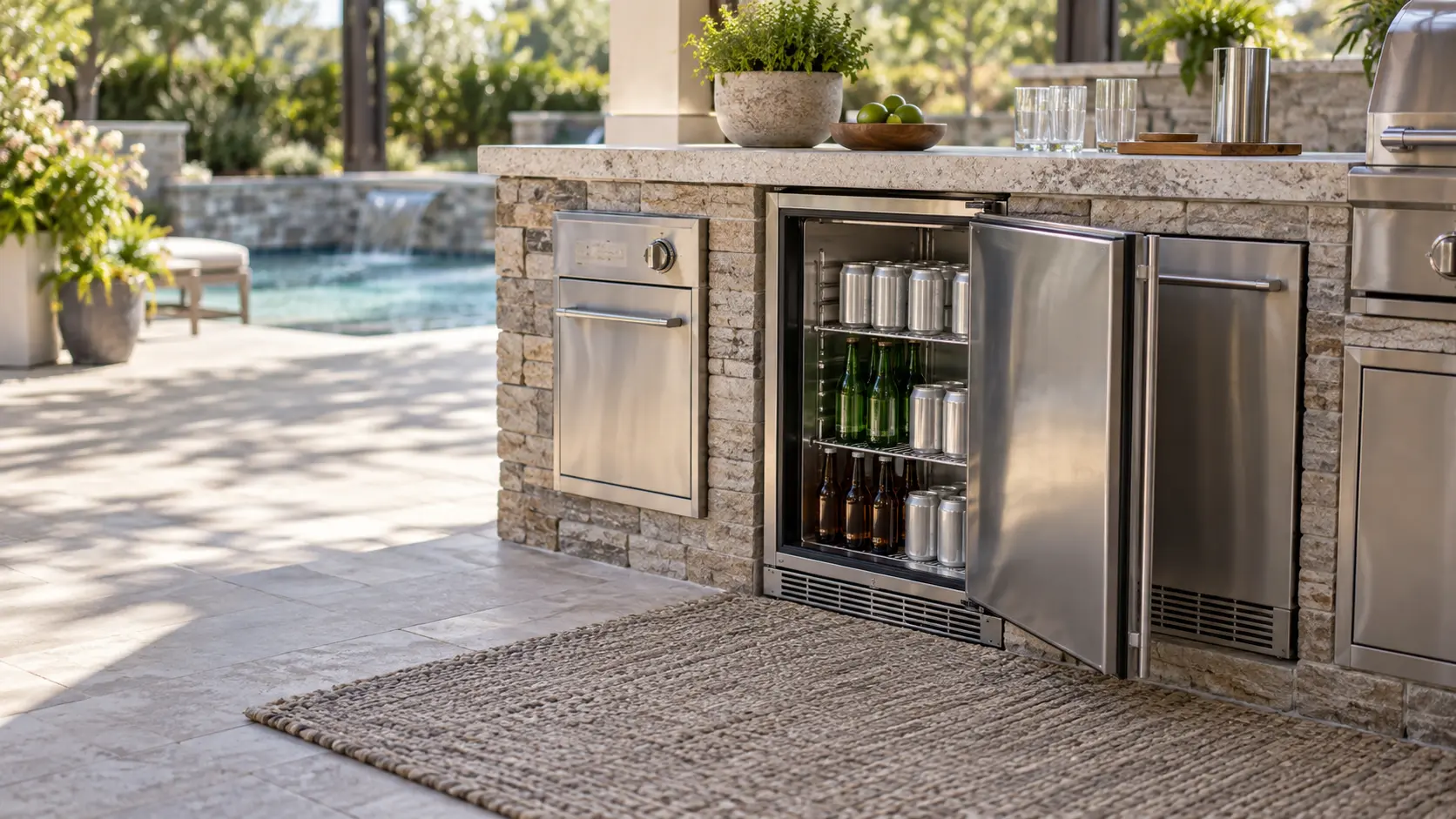
A rating is a promise about exposure, not about every climate. True Residential describes every one of its undercounter cabinets as UL-rated for outdoor settings, yet the same guide still asks for a flush install with the countertop over the door gasket and notes that gaskets do not make a watertight seal against the elements. The rating means the cabinet, wiring and controls were built to live outside; the installation still decides how well it copes.
Every rated cold unit also has a working window. Perlick's G5 manual lists a lower ambient limit of 38°F for its refrigerator and beverage models, 32°F for freezers and 42°F for wine units, with 105°F as the upper limit for all three, and warns that running outside those figures can damage the equipment and may void the warranty.
Two manuals for the same ice maker
Scotsman sells its SCCG50 and SCCP50 ice makers in an indoor version and an outdoor version, and reading the two manuals side by side shows exactly what the outdoor badge adds. The indoor edition says the machine is designed for use indoors in a controlled environment. The outdoor edition opens with a notice: keep it from freezing, keep it dry and out of low spots where puddles form, give it shade because sun and ultraviolet light cut output and can harm the plastic parts, and never drain it into a pool or onto the ground.
Source: True Residential — 15 and 24 Inch Undercounter Install Guide and User's Manual — All True undercounter units are UL-rated for outdoor use; flush install with the countertop over the gasket; gaskets are not a watertight seal against the elements; Perlick — G5 User Installation and Operation Manual (Form Z3023) — Lower ambient limits of 38°F (refrigerator/beverage), 32°F (freezer), 42°F (wine), upper 105°F; coastal grade recommended within 1 mile of the coast, up to 5 miles, and near pools
What happens when an indoor unit lives on the patio
An indoor cold unit is sized for a kitchen or a basement bar, where the air rarely strays far from room temperature. Outside, the compressor meets hotter air at the condenser on a summer afternoon and much colder air on a winter night, and the controls, door heaters and plastic parts were never chosen for either. The unit may work for a season, which is why the problem is so often traced back to the location only after the repair bill arrives.
These are the patterns we see most often when an indoor model has been built into an island:
- Drinks never get properly cold on hot afternoons, then recover overnight.
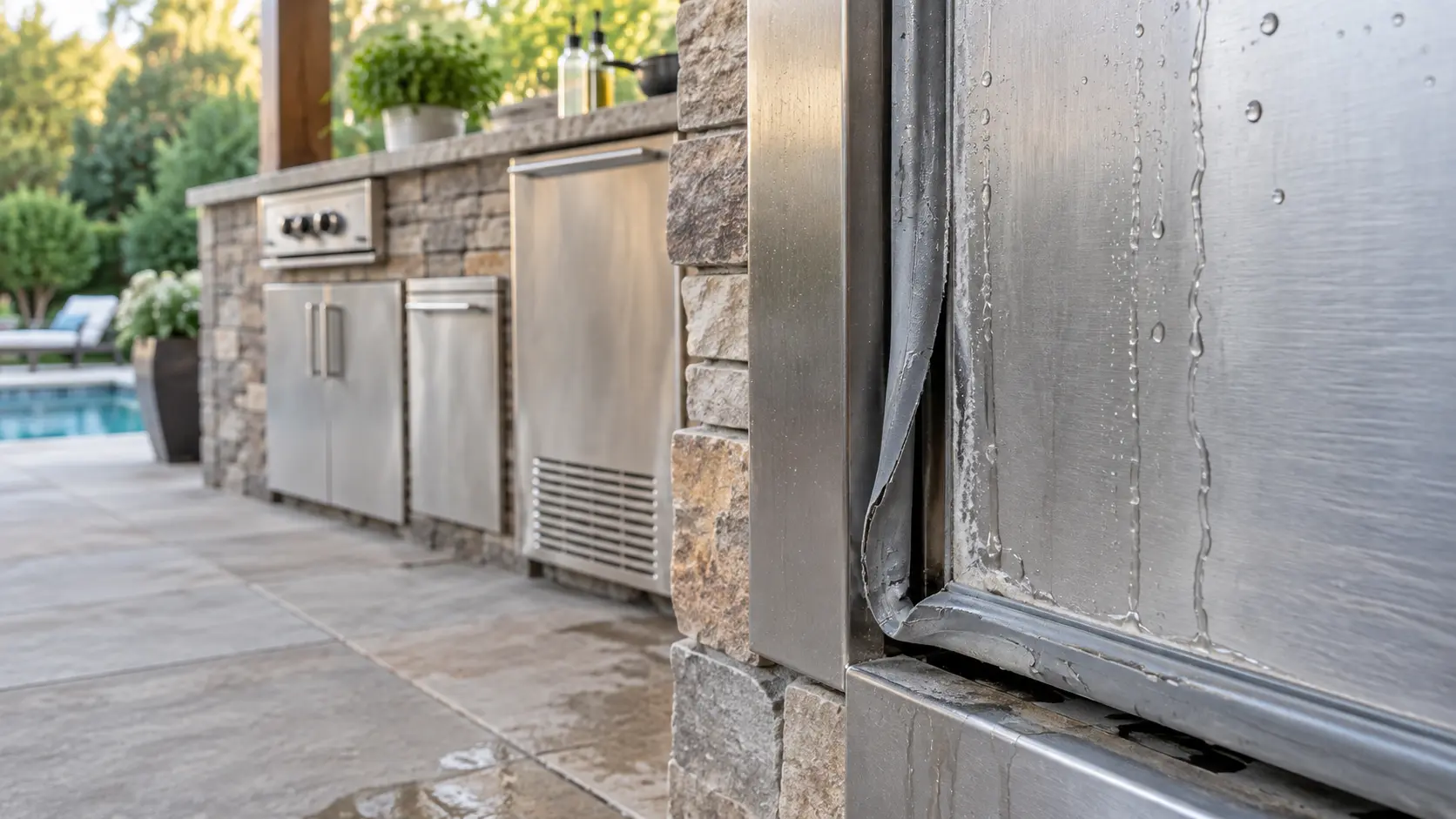
- Condensation beads on the door frame and drips onto the floor of the cutout.
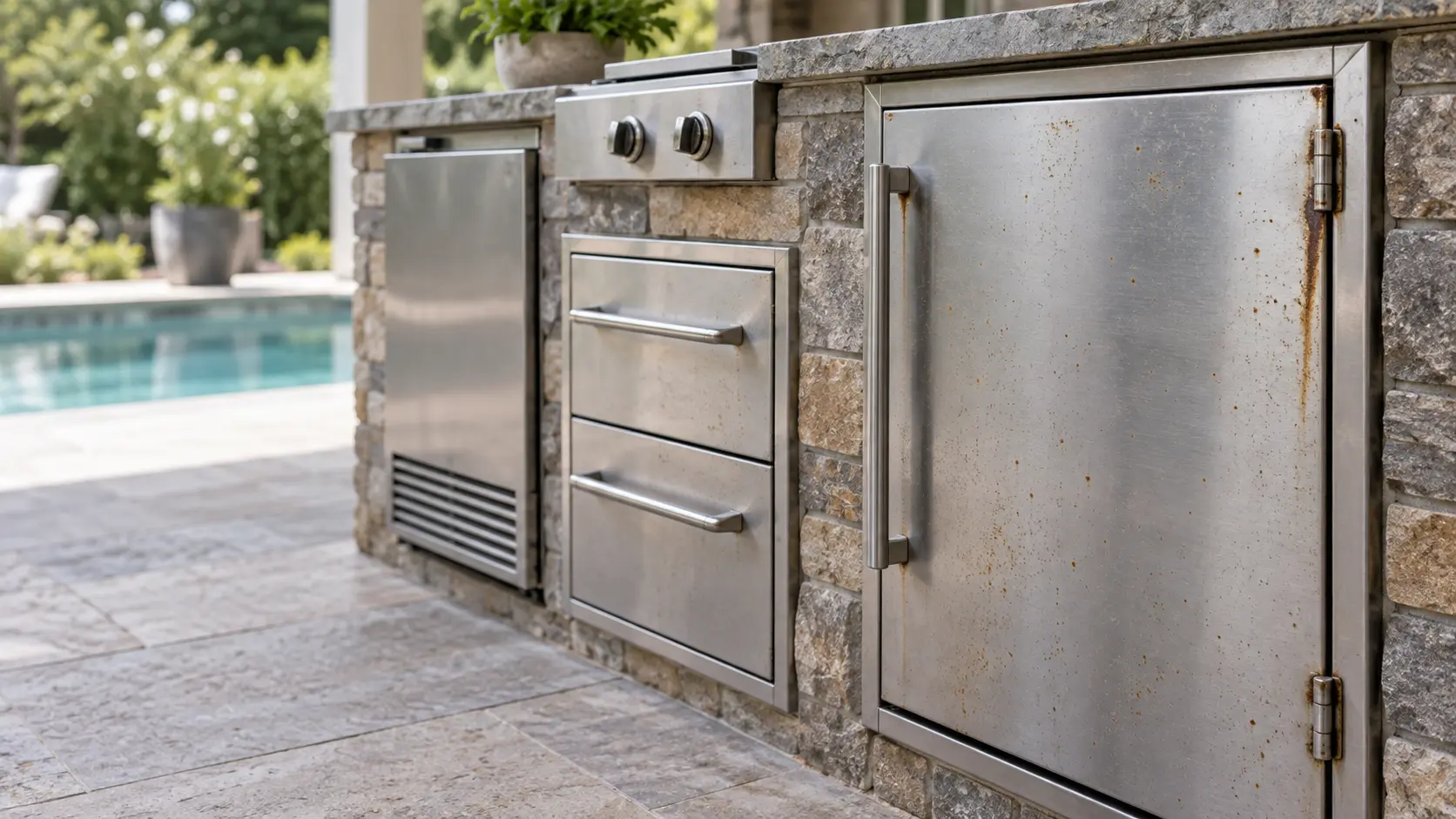
- Rust spots appear on screws, hinges and the lower frame long before the door skin shows any.
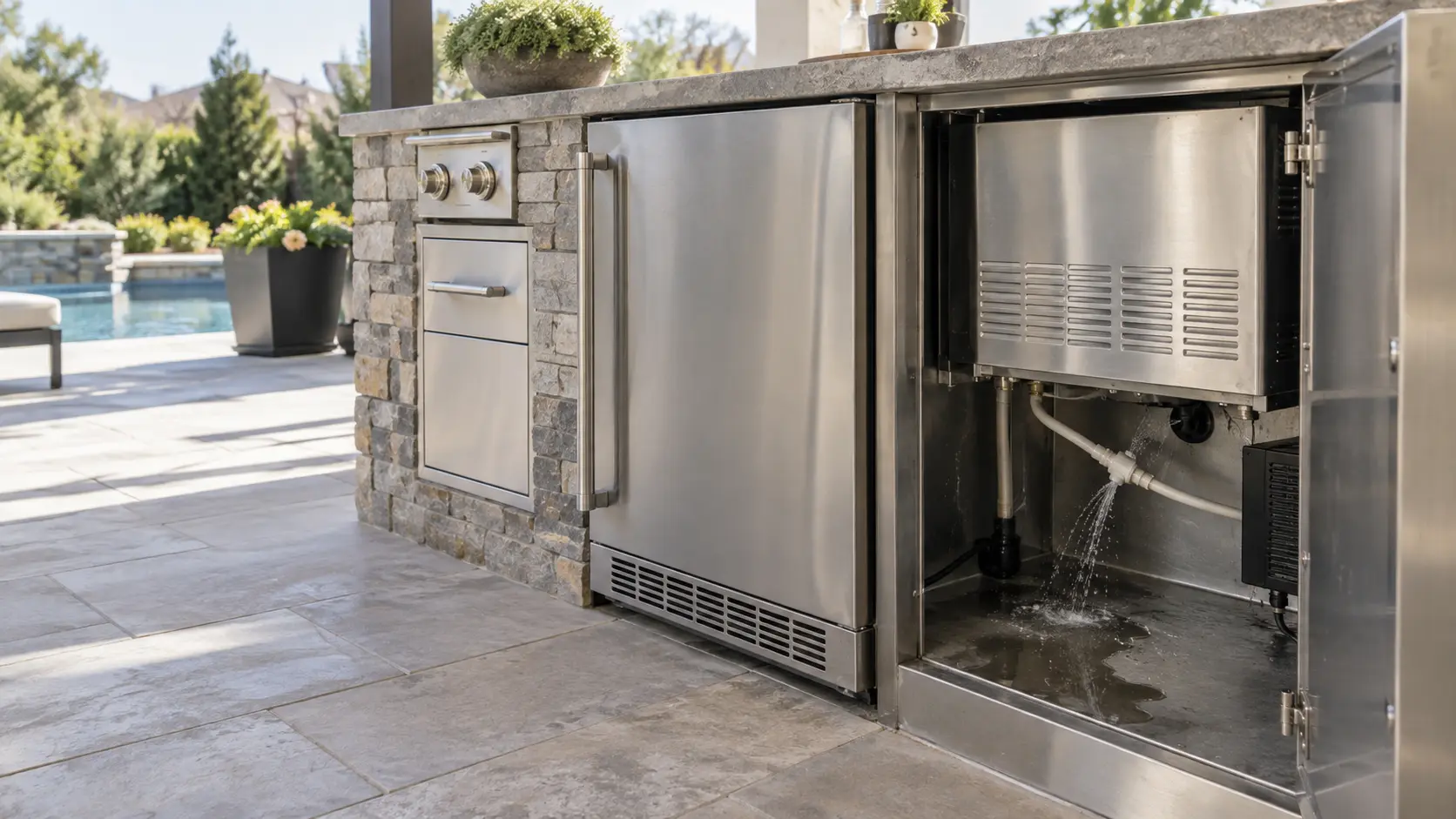
- The ice maker produces thin, slow batches in summer and splits a line or valve after the first freeze.
- Plastic trim and the door gasket turn chalky or brittle where the afternoon sun reaches them.

Salt air, pool water and the grade of steel
The outdoor kitchen that sits beside a pool or within a few miles of the ocean asks more of its stainless steel than one inland. Perlick recommends its coastal grade units for installations within 1 mile of the coast, and up to 5 miles depending on local conditions, and for any spot near a pool. Lynx makes the same point about its own 304 stainless: chlorine in the air around pools and salt carried on sea air can bring out surface rust and even pitting if it is left on the metal.
A rated unit with a standard finish can still do well in those places, provided it is rinsed and wiped often. The rust guide in the maintenance section explains the routine that keeps the protective film on the steel intact.
A roof overhead changes the sun, not the air
Owners sometimes choose an indoor model because the island stands under a pergola or a solid patio roof. Shade helps every appliance, yet the air under that roof still carries summer heat, winter cold, humidity and whatever the wind brings from the pool deck. For the purpose of choosing a unit, a covered patio is outdoors.
Source: Perlick — G5 User Installation and Operation Manual (Form Z3023) — Lower ambient limits of 38°F (refrigerator/beverage), 32°F (freezer), 42°F (wine), upper 105°F; coastal grade recommended within 1 mile of the coast, up to 5 miles, and near pools; Lynx — Professional Series Care and Use / Installation Manual — Chlorine from swimming pools or salt from sea air may cause surface rust and pitting on 304 stainless steel
Side burners and warming drawers are outdoor products from the start
The choice between rated and indoor is mostly about cold units and ice makers. Side burners, power burners and outdoor warming drawers are built for islands in the first place, and their manuals speak to the weather rather than around it. Alfresco's warming drawer manual states that the unit is intended for outdoor use, asks for its receptacle to sit under the counter away from the elements and recommends a GFCI receptacle.
What still varies between models is the finish, the gauge of the steel and how the controls are sealed, so it is worth comparing those when two burners look alike on the showroom floor.
Why an indoor warming drawer is a poor stand-in
A kitchen warming drawer is designed to sit under a wall oven in a heated room, wired into a protected cabinet. In an island it meets wet air, blown rain at the front and wide temperature swings, and any failure in its wiring sits close to a counter where people cook. If the island opening was cut for an indoor drawer, ask the island builder about fitting an outdoor model before the old one is simply replaced like for like.
Kegerators and cold drawers follow the same rule
A kegerator or a pair of cold drawers is a cold unit like any other, with a compressor and condenser that breathe at the front. Look for the outdoor rating in its manual and check the published air temperature window, since drawer models are often offered in both indoor and outdoor versions that look nearly identical.
Source: Alfresco — AXEWD-30 Warming Drawer Care and Use Manual — Unit intended for outdoor use; receptacle under the counter away from the elements; GFCI receptacle recommended
Questions to settle before you order
A few minutes with the manual, which most makers post online, answers more than any brochure. We suggest checking these points for every cold unit and ice maker you are considering:
- Does the installation section say outdoor use, and in which words?
- What are the lowest and highest air temperatures the maker allows?
- Does it ask for a flush install, a rear vent in the cutout or a minimum opening depth?
- Is there a coastal or marine grade version for homes near salt water or a pool?
- What does the manual ask you to do in winter, and does it allow a cover?
- Where must the outlet sit, and does the maker call for GFCI protection?