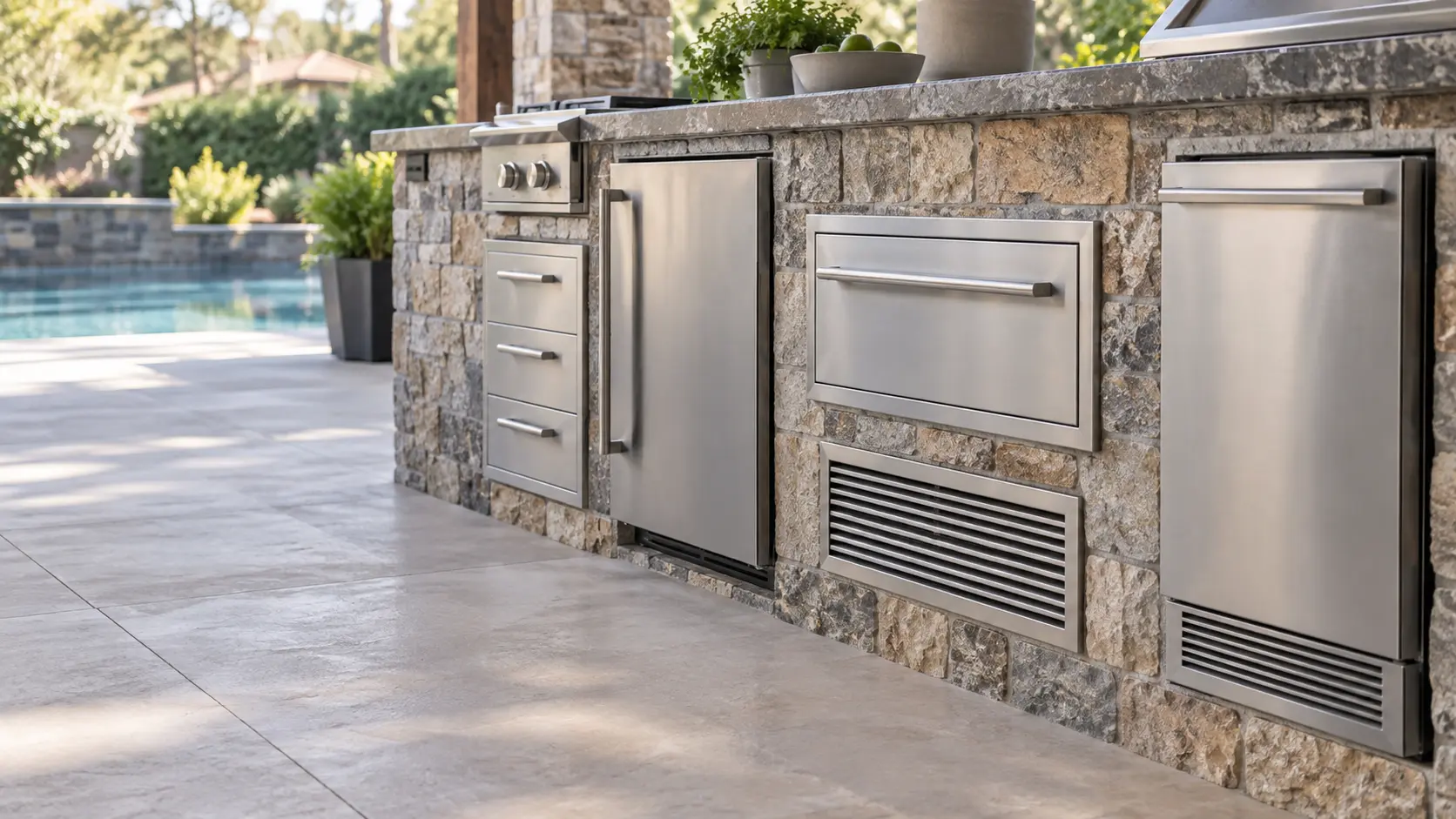
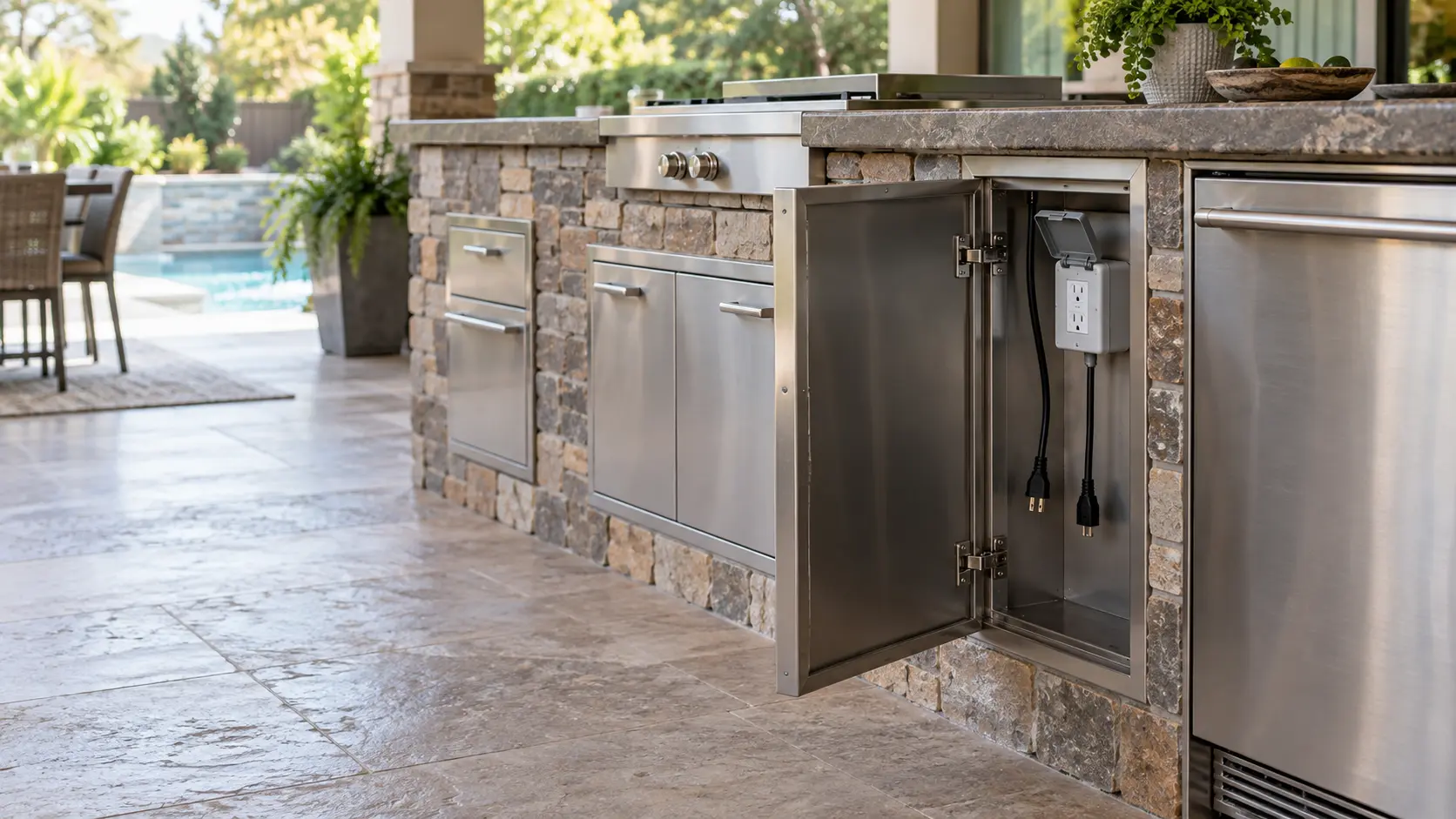
The circuit each outdoor kitchen cooler expects
Planning power and water to an outdoor kitchen starts with the cold units, which plug into an ordinary grounded outlet, but the makers are specific about what stands behind it. U-Line asks for a grounded, polarized 115-volt, 60-hertz, 15-amp supply, recommends an individual branch circuit and says the receptacle should be placed by a qualified electrician under state and local codes. True calls for a 15-amp supply and a dedicated circuit for each unit, and asks for the outlet to be checked by an electrician to confirm it is properly grounded.
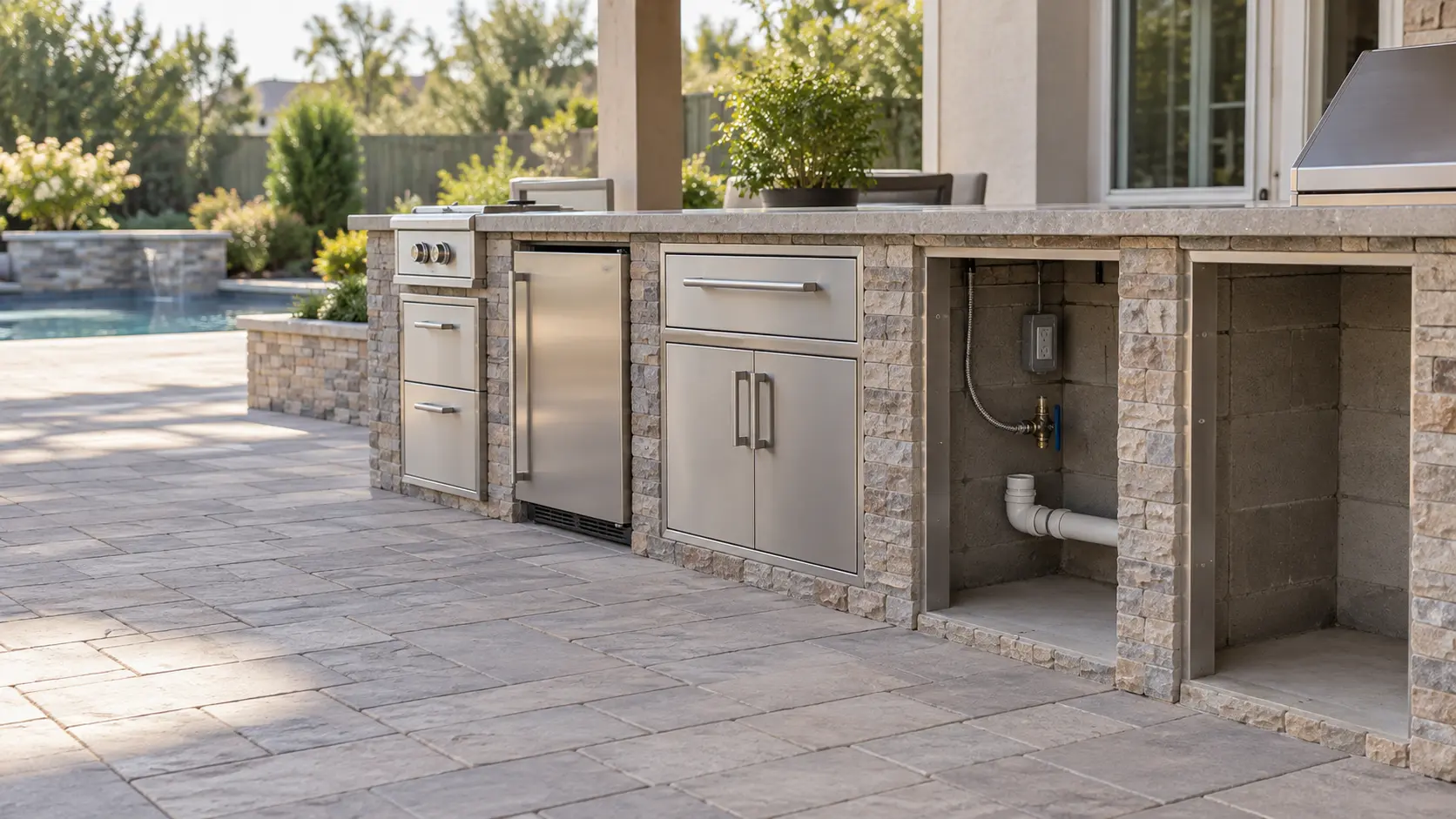
An island with a cooler, cold drawers and an ice maker therefore wants more than one circuit, and a side burner with an electric igniter or lights adds to the load. That is a plan to settle with the electrician before the trench is filled, not after the countertop is set.
- A three-prong grounded receptacle for every cord-connected unit.
- The unit's own circuit, as the maker specifies.
- Never an extension cord or a two-prong adapter; U-Line and True both forbid them for their cold units.
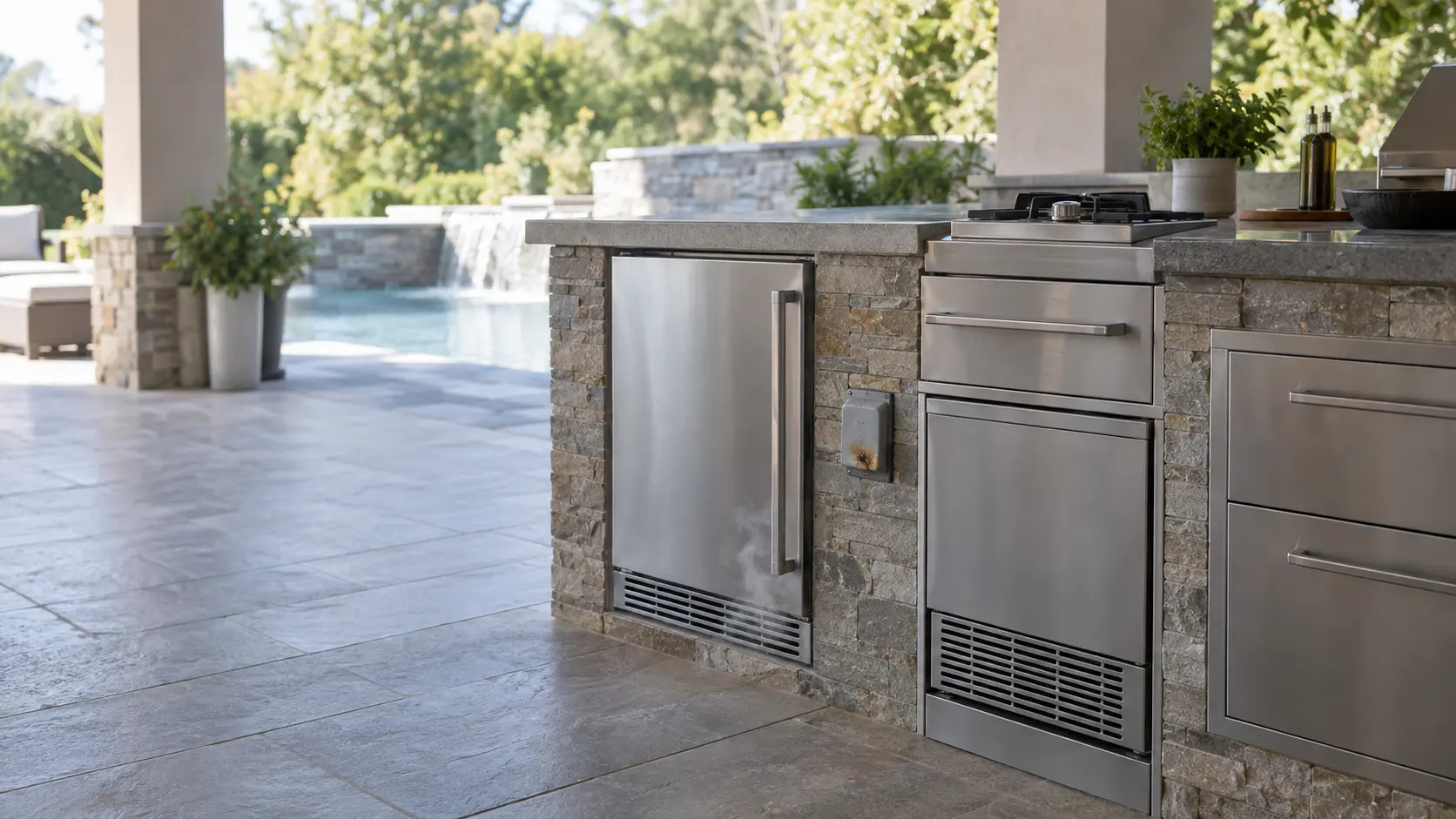
- Never a cut, altered or rewired cord; U-Line warns it can cause fire or injury.
Source: U-Line — UORE124 Outdoor User Guide and Service Manual — Grounded, polarized 115 V, 60 Hz, 15 A supply; individual branch circuit recommended; receptacle placed by a qualified electrician; no extension cord or two-prong adapter; no cutting or altering the cord; GFCI usually not required for fixed appliances and not recommended because of nuisance tripping, consult local codes; True Residential — 15 and 24 inch Undercounter Install Guide and User's Manual — 115 V, 15 A supply; a dedicated circuit for each unit; outlet checked by a qualified electrician for grounding; no extension cord or two-prong adapter
GFCI protection and why the manuals seem to disagree
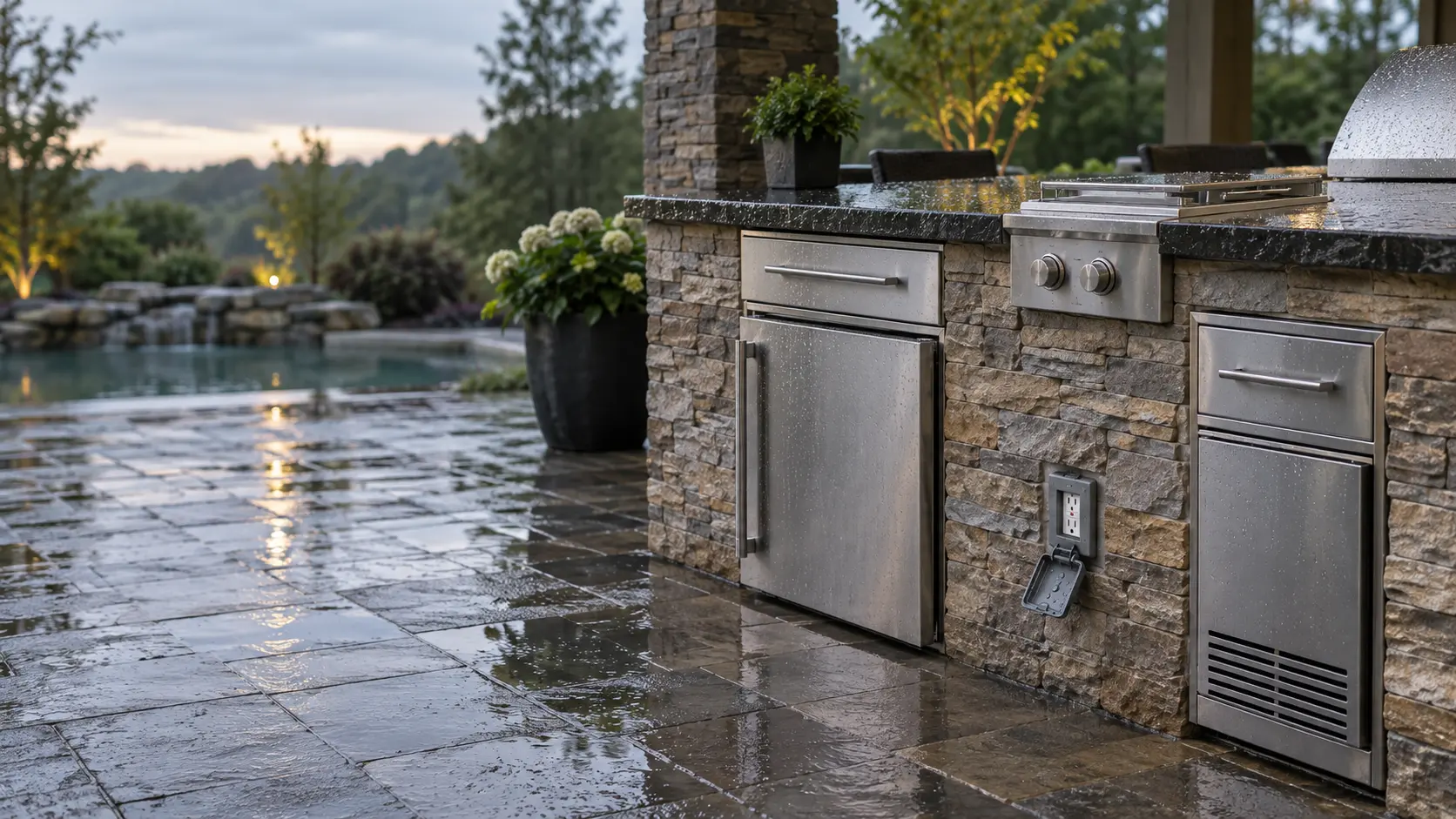
A GFCI watches the current going out and coming back on a circuit and cuts the power when they differ by as little as 0.006 amperes, fast enough to prevent a lethal shock. CPSC's fact sheet notes that the National Electrical Code has called for GFCI protection on outdoor receptacles since 1973, and that the code usually applies to new construction and major renovation. Lynx, for its side burners with electric ignition, says to use only a GFCI-protected circuit.
Refrigeration makers add a caution. U-Line says a GFCI is usually not required for a fixed-location appliance and is not recommended for its unit because it can be prone to nuisance tripping, then tells the owner to consult local codes. The two do not cancel each other out: the local code and the electrician decide what protects the island's outlets, and the refrigeration makers' note simply explains why a GFCI outdoors sometimes trips with nothing visibly wrong.
Testing the GFCI yourself
CPSC asks for every GFCI to be tested after installation, once a month and after a power failure, since outages can damage one. Its method is simple: plug in a lamp, switch it on, press the test button and watch the light go out, then press reset and watch it come back. If the light stays on after the test, or never returns, CPSC's advice is to call a qualified electrician.
Wet weather and a trip
A GFCI that trips during rain is doing its job until proved otherwise. Reset it once, from a dry spot and with dry hands, after the rain has stopped. If it trips again with water around, leave it off and switch off the breaker at a dry panel; repeated trips are a wiring or appliance problem for an electrician or a technician.
Source: CPSC — What Is a GFCI? (fact sheet, Publication 099) — A GFCI interrupts power at a difference as small as 0.006 amperes; the NEC has required it for outdoor receptacles since 1973 and applies mainly to new construction and major renovation; test after installation, monthly and after a power failure, with the lamp method; call a qualified electrician if it does not work; U-Line — UORE124 Outdoor User Guide and Service Manual — Grounded, polarized 115 V, 60 Hz, 15 A supply; individual branch circuit recommended; receptacle placed by a qualified electrician; no extension cord or two-prong adapter; no cutting or altering the cord; GFCI usually not required for fixed appliances and not recommended because of nuisance tripping, consult local codes; Lynx — Side Burner Accessory Care, Use and Installation Manual — Use only a GFCI-protected circuit with the outdoor cooking gas appliance

Water to an outdoor ice maker
The outdoor ice maker is usually the only appliance in an island that needs plumbing in both directions. U-Line's manual for its outdoor clear-ice unit asks for a connection to potable cold water only, at 20 to 120 psi, with a shutoff valve on the supply line, and advises against any plastic supply line because the line is under pressure all the time and plastic can crack with age. It also calls for backflow protection to meet federal, state and local codes.
U-Line states that these connections are the owner's responsibility and must meet the local plumbing code, and it recommends a plumber for anyone unsure. On an island, where the line runs underground and through masonry, that plumber is the right call from the start.
Know where the water shutoff is
The shutoff valve on the ice maker's supply is the one you will reach for when a line weeps or a freeze is coming. Ask the plumber where it is, keep the bay in front of it clear, and label it; in a large island it can be easy to confuse with an irrigation valve.
Source: U-Line — UOCP115 Outdoor Clear Ice Maker User Guide and Service Manual — Potable cold water at 20 to 120 psi with a shutoff valve; no plastic supply line; backflow protection per codes; connections are the owner's responsibility per local plumbing code, with a plumber if unsure; gravity drain falls 1/4 inch per foot, no traps, vented, not below the unit; drain pump lifts up to 10 feet
Gravity drain or a pump
Meltwater has to leave the ice maker, and U-Line gives two ways out. A gravity drain works when the line falls at least 1/4 inch per foot away from the unit, has no traps and is vented per local code; the floor drain must be large enough for everything that runs into it. The drain cannot sit directly under the unit, because the base is solid.
Where the water has to go up to a standpipe or a sink tailpiece, U-Line offers a drain pump that lifts it as much as 10 feet. Models sold with a pump have it fitted at the factory, and U-Line also sells the pump as a part; without one, the unit drains by gravity only.
Signs the drain was not planned well
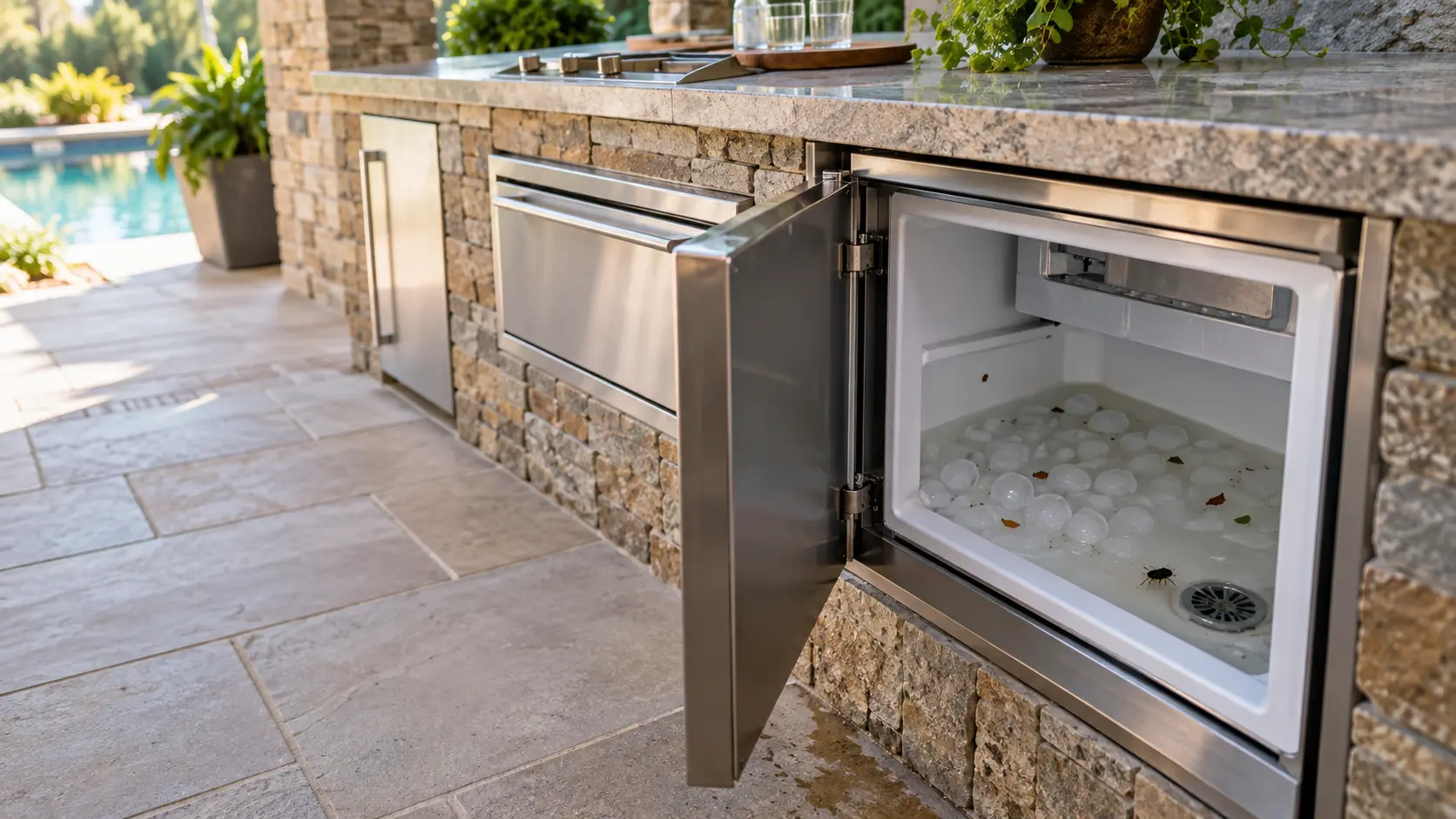
- Water standing in the ice bin, or ice that comes out wet and clumped.
- A puddle forming in the island bay under the ice maker.
- A line that sags or climbs on its way out of the island.
- A drain line that freezes in the first cold snap because nobody emptied it for winter.
Source: U-Line — UOCP115 Outdoor Clear Ice Maker User Guide and Service Manual — Potable cold water at 20 to 120 psi with a shutoff valve; no plastic supply line; backflow protection per codes; connections are the owner's responsibility per local plumbing code, with a plumber if unsure; gravity drain falls 1/4 inch per foot, no traps, vented, not below the unit; drain pump lifts up to 10 feet
Who does which part
Splitting the work up front saves a second trench. The electrician runs the circuits, sets the receptacles and fits GFCI protection as code requires. The plumber brings the potable water, the shutoff, backflow protection and the drain or pump outlet. The gas fitter handles the gas line and its shutoff, which is a separate job and never the owner's. The owner's part is smaller and ongoing: test the GFCI monthly, keep outlet covers closed in the rain, keep every shutoff reachable and never plug a cold unit into an extension cord.