Why an outdoor kitchen island needs vents at all
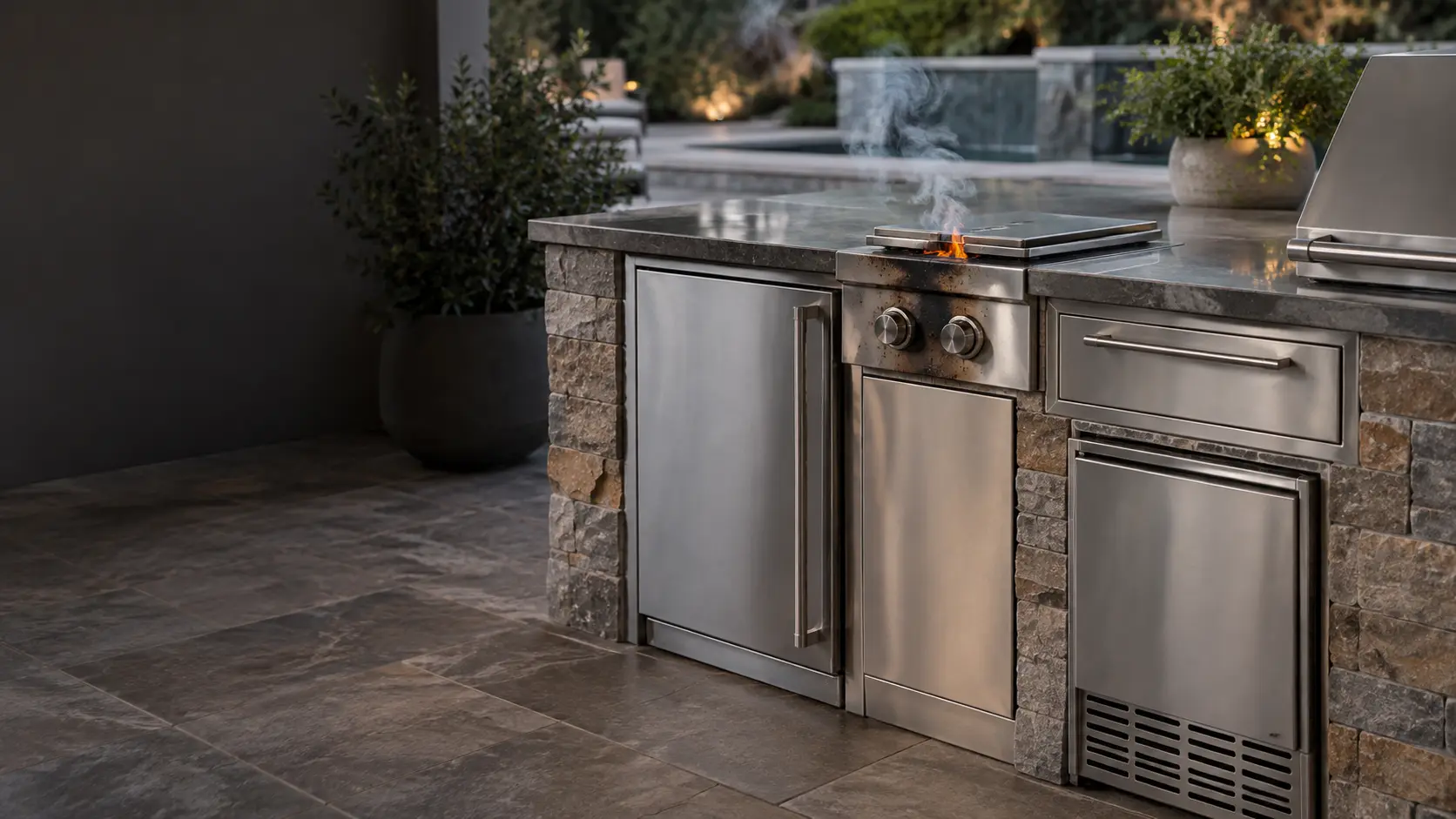
Blaze opens the ventilation section of its installation manual with a warning: failing to vent the outdoor kitchen cavity adequately could result in an explosion or fire. Outdoor kitchen island vents exist for a simple reason: every gas appliance in an island has a connection, a valve and often a regulator inside a closed box, and if any of them seeps, the gas has nowhere to go unless the builder gave it a way out.
Lynx says the same about its built-in side burners: the enclosure should have ventilation holes to prevent gas from building up in the event of a leak, and it points installers to the enclosure section of ANSI Z21.58, the standard for outdoor cooking gas appliances. Blaze adds that the openings also help with combustion air, which is why the same vents serve the burners on an ordinary evening.
The shell around the vents
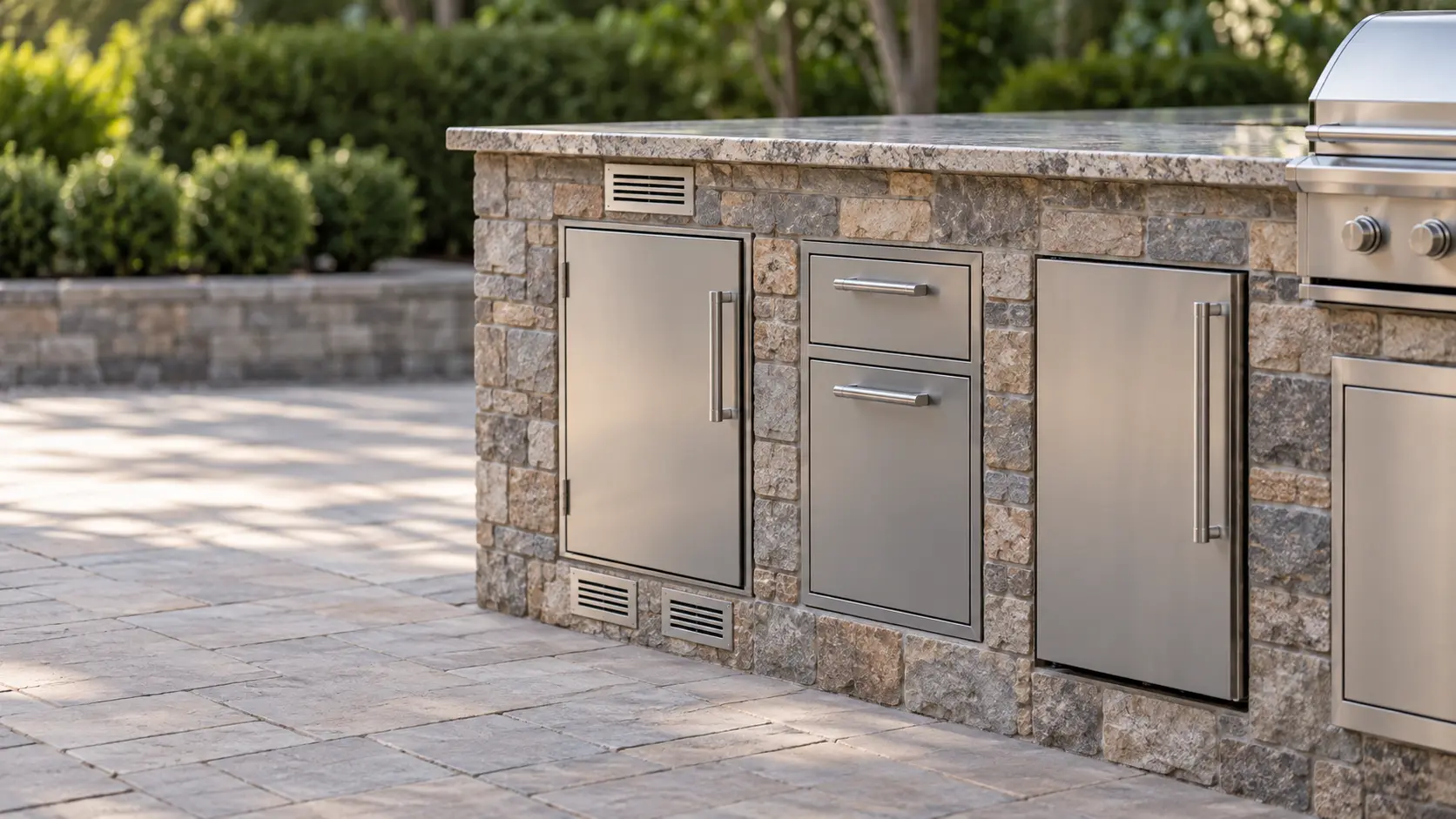
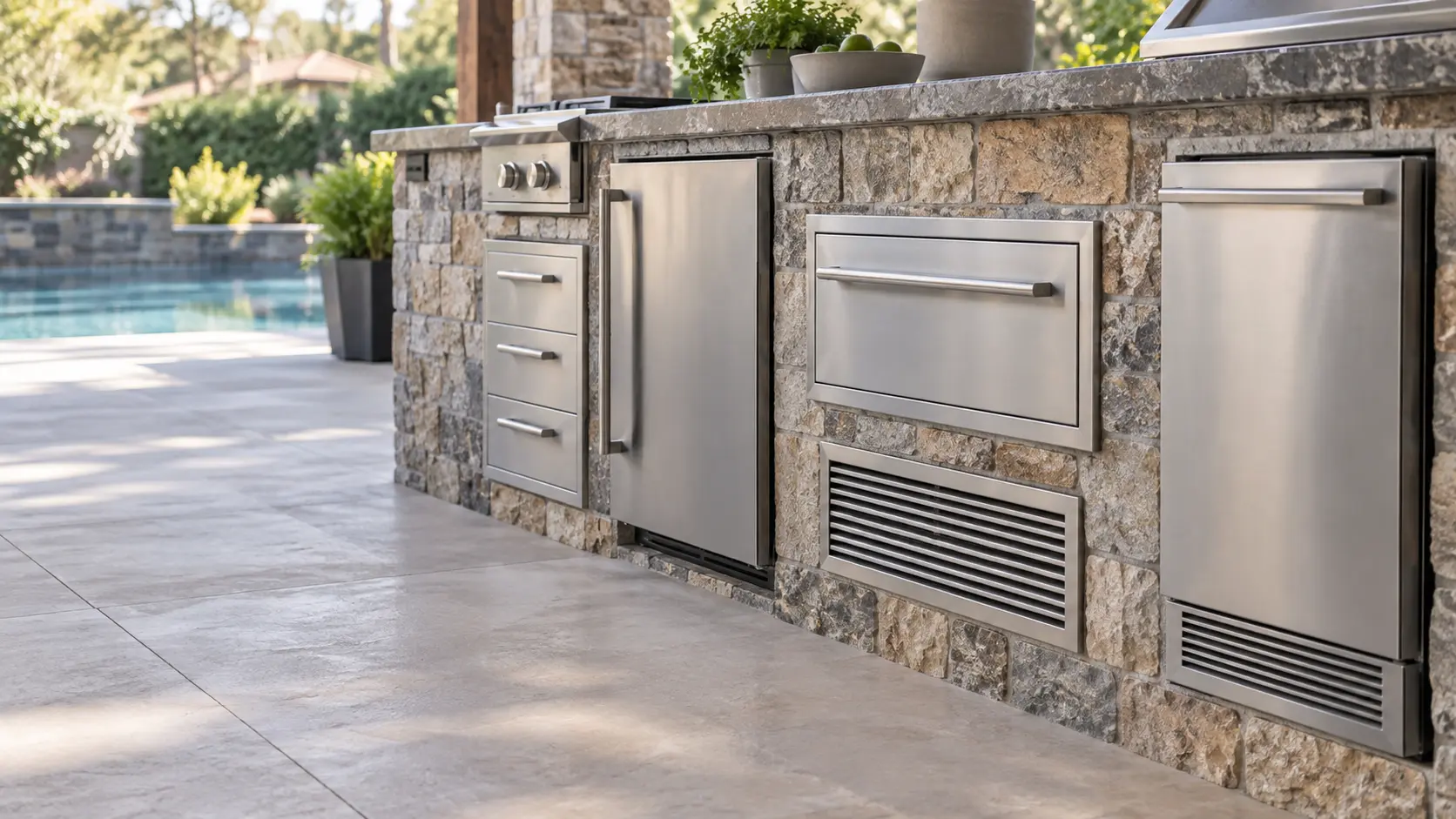
Both makers expect the island to be built from non-combustible materials; Lynx says its built-in burners must never go into a combustible enclosure, and Blaze leaves the call on what counts as non-combustible to the local building authority. Vents are cut into that shell and covered with stainless panels, which Blaze notes are sold for the purpose.
Source: Blaze — Professional Series Use and Care Guide (BLZ-PRO), Outdoor Kitchen Ventilation — Inadequate venting could result in explosion or fire; vents serve combustion and prevent gas build-up; propane settles low and natural gas rises, both need cross ventilation; a tank in the island needs a plenum wall or tank drawer and ventilated bays; amount set by local contractor or code authority; stainless vent panels; gas line routing, accessible shutoff, leak test before first use, removable control panel; keep openings clear; Lynx — Side Burner Accessory Care, Use and Installation Manual — The enclosure should have ventilation holes to prevent gas build-up after a leak, referring to ANSI Z21.58 section 1.7 on enclosures for self-contained propane supplies; built-in units only in non-combustible enclosures; no spare cylinders in the cabinet
Low vents for propane, high vents for natural gas
Where the openings go depends on the fuel, and Blaze explains both cases. The aim either way is cross ventilation: openings on opposite sides of the bay so outside air can move through it rather than stall in a corner.
Islands that were converted from one fuel to the other, or that run a propane side burner beside a natural gas cooking head, are the ones to look at twice. The vent pattern should match the gas that is actually piped in today.
Propane settles to the floor of the island
Propane is heavier than air, so a leak runs downhill and pools at the lowest level of the cabinet. Blaze calls it imperative to provide cross ventilation where the gas can gather at those lower levels, and its diagram shows the vents for a propane island set noticeably lower than those for natural gas.
Natural gas rises under the countertop
Natural gas is lighter than air and climbs to the highest point of the cavity, just below the counter slab. The cross vents belong up there, in the upper part of the side walls, so gas that seeps from a fitting can slip out rather than gather under the stone.
Source: Blaze — Professional Series Use and Care Guide (BLZ-PRO), Outdoor Kitchen Ventilation — Inadequate venting could result in explosion or fire; vents serve combustion and prevent gas build-up; propane settles low and natural gas rises, both need cross ventilation; a tank in the island needs a plenum wall or tank drawer and ventilated bays; amount set by local contractor or code authority; stainless vent panels; gas line routing, accessible shutoff, leak test before first use, removable control panel; keep openings clear

When the propane tank lives inside the island
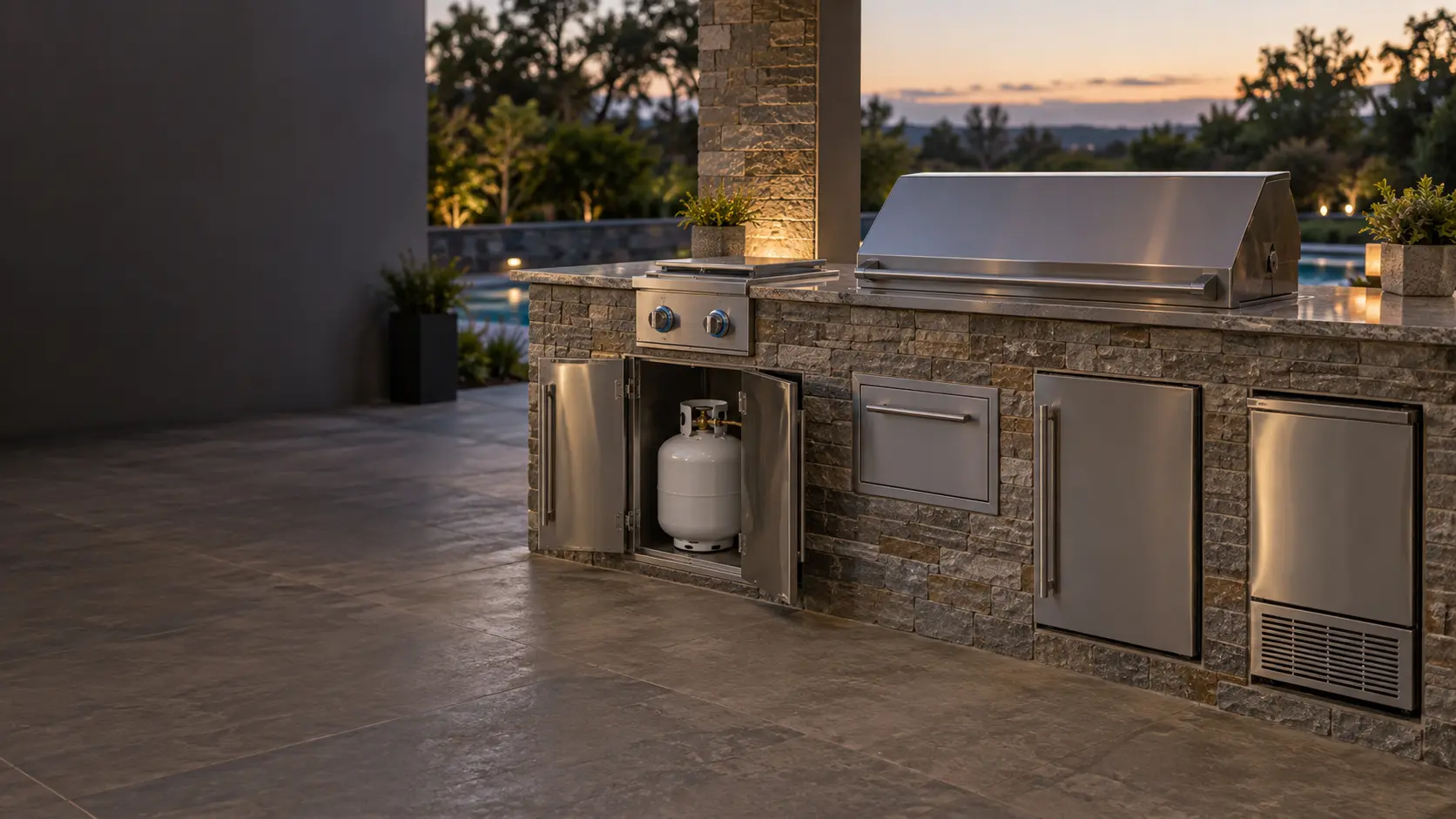
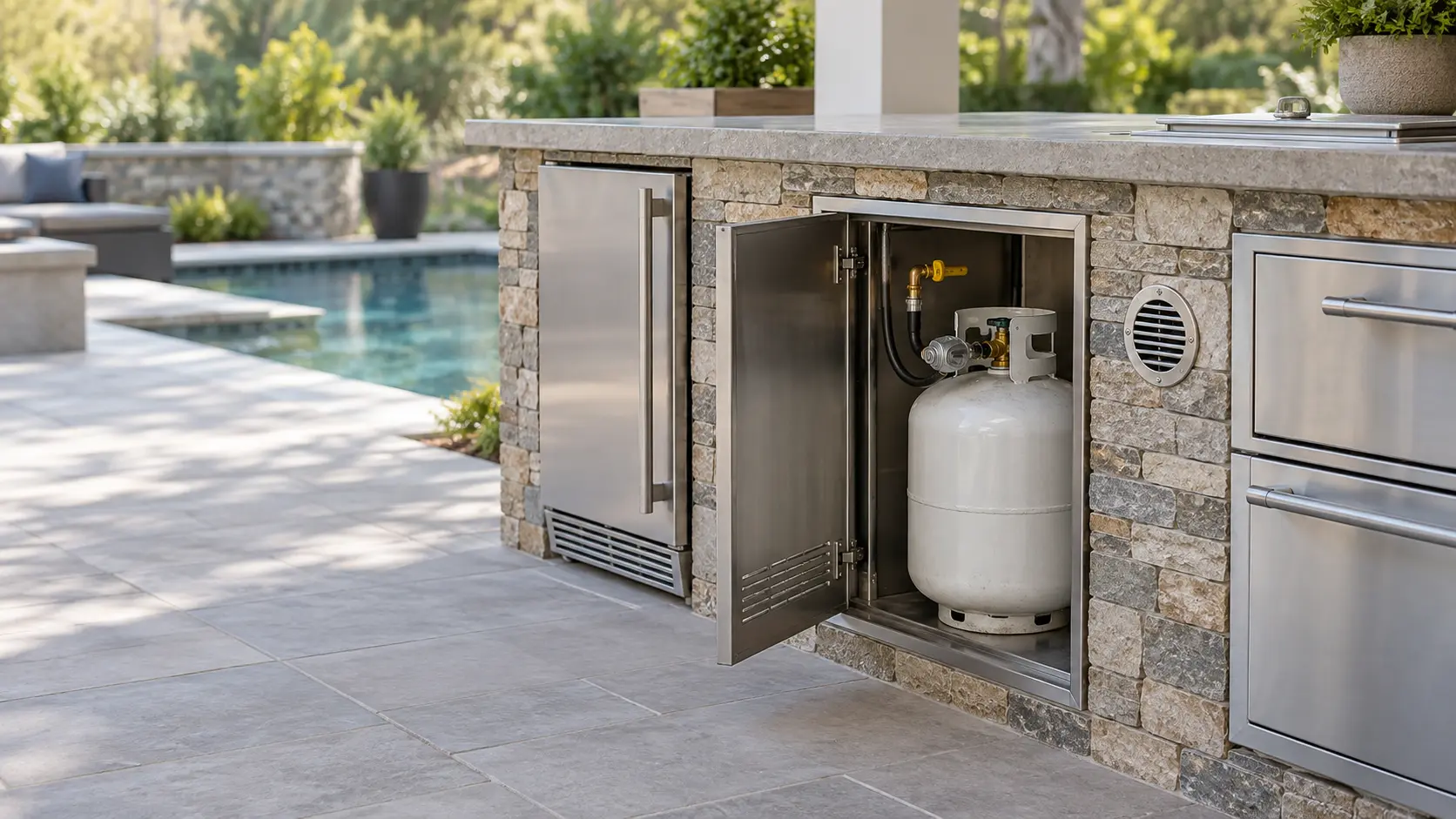
A tank tucked into the island is tidy, and it is also the one spot where gas is stored rather than just piped. Blaze says that when the cylinder sits in the outdoor kitchen itself, a plenum wall is required to separate it from the rest of the island, and both the cabinets with gas appliances and the tank bay must be ventilated; a tank drawer is its alternative to the wall. Lynx refers installers to the part of ANSI Z21.58 that covers enclosures for self-contained propane supplies.
- The tank bay is closed off from the other bays by its own wall.
- The tank bay has its own openings to open air, as does every cabinet holding a gas appliance.
- A spare cylinder is never stored in the island or beside it; CPSC and Lynx both rule that out.
- Gasoline and other flammable liquids stay out of every bay.
- The tank valve is reachable without moving anything stored in front of it.
Source: Blaze — Professional Series Use and Care Guide (BLZ-PRO), Outdoor Kitchen Ventilation — Inadequate venting could result in explosion or fire; vents serve combustion and prevent gas build-up; propane settles low and natural gas rises, both need cross ventilation; a tank in the island needs a plenum wall or tank drawer and ventilated bays; amount set by local contractor or code authority; stainless vent panels; gas line routing, accessible shutoff, leak test before first use, removable control panel; keep openings clear; Lynx — Side Burner Accessory Care, Use and Installation Manual — The enclosure should have ventilation holes to prevent gas build-up after a leak, referring to ANSI Z21.58 section 1.7 on enclosures for self-contained propane supplies; built-in units only in non-combustible enclosures; no spare cylinders in the cabinet; CPSC — Safety Checks for the Grill (fact sheet, Publication 467) — Never store a spare propane container under or near the appliance; never store or use flammable liquids nearby
What the installer decides and does
Blaze does not print one size for all islands, and says why: the right amount of venting depends on local codes, the framework inside the island, how many gas appliances it holds and where they sit. It leaves the determination to the local contractor or the code authority, and it expects every island with built-in gas equipment to be vented in some way.
The same manual lists the rest of the installer's gas work, and none of it is an owner's job. It is worth knowing so you can ask about it when the island is built or when you buy a house that has one.
The installer's side of the job
- Size and cut the vents for the fuel and the island, to local code.
- Route the gas line away from heat, sharp edges and rough surfaces, with as few bends as possible.
- Fit a shutoff valve at the gas connection and keep it reachable once the appliance is in.
- Leak-test every gas connection after installation and before the first use of any appliance.
- Leave the removable control panel unsealed so it can come out for service later.
Source: Blaze — Professional Series Use and Care Guide (BLZ-PRO), Outdoor Kitchen Ventilation — Inadequate venting could result in explosion or fire; vents serve combustion and prevent gas build-up; propane settles low and natural gas rises, both need cross ventilation; a tank in the island needs a plenum wall or tank drawer and ventilated bays; amount set by local contractor or code authority; stainless vent panels; gas line routing, accessible shutoff, leak test before first use, removable control panel; keep openings clear
Keeping the vents working for years
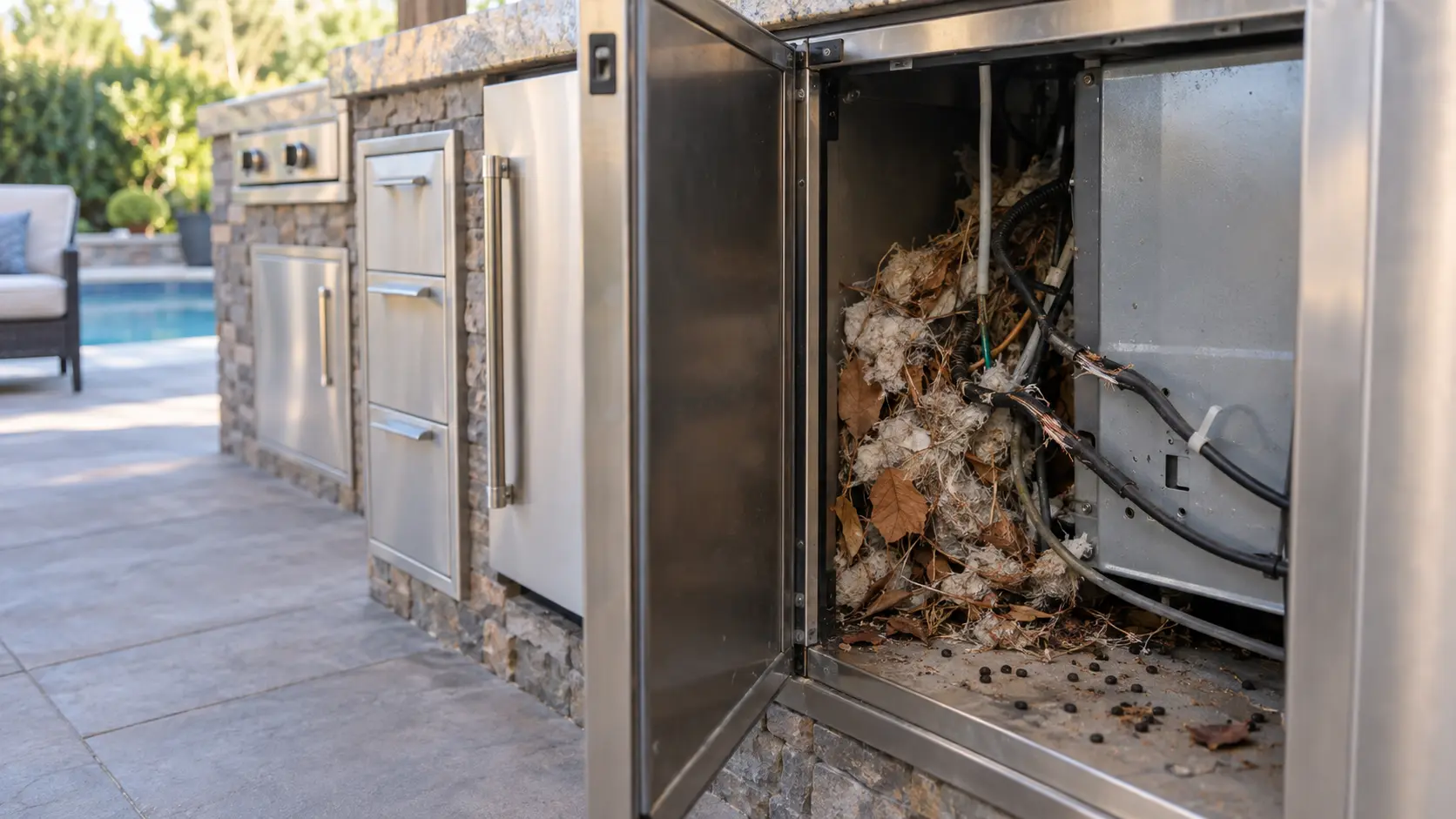
Blaze asks owners to keep the enclosure's ventilation openings free and clear, and that is where most vents fail: not in the design but in what piles up against them. Planters pushed tight to the island, a bag of charcoal or pool toys stored in the bay, a cover that drapes to the pavers, mulch or leaves banked against a low vent, or a later stone veneer laid over an opening all undo the builder's work.
If you have inherited an island, take a minute to find its vents. A propane island with no openings near the bottom of the gas bays, or a natural gas island with none near the top, is worth a professional look before the next season rather than after a smell.
Source: Blaze — Professional Series Use and Care Guide (BLZ-PRO), Outdoor Kitchen Ventilation — Inadequate venting could result in explosion or fire; vents serve combustion and prevent gas build-up; propane settles low and natural gas rises, both need cross ventilation; a tank in the island needs a plenum wall or tank drawer and ventilated bays; amount set by local contractor or code authority; stainless vent panels; gas line routing, accessible shutoff, leak test before first use, removable control panel; keep openings clear